Your packaging is doing the selling work before anyone reads a single word of copy. That’s why finding the best packaging partners isn’t just a procurement decision; it’s a brand decision.
The challenge is real: scaling production without compromising quality, hitting environmental targets without blowing the budget, and keeping print consistency tight across every run.
After reviewing dozens of providers across the packaging manufacturing space, the companies that consistently deliver combine smart tech, real certifications, and low minimums that actually work for growing brands.
This guide covers five of the strongest options available right now.
The research approach for this ranking
Publicly available data formed the foundation of this evaluation, drawing from official company websites, customer review patterns, directory listings, and documented case studies. Only providers with a verifiable track record in packaging manufacturing made the cut, with attention paid to both operational proof points and real-world client outcomes.
-> See the full research breakdown
- Arka – Best for e-commerce and DTC brands seeking sustainable, customizable packaging
- Packlane – Best for custom packaging design and printing
- Packola – Best for custom packaging for small businesses and entrepreneurs
- BoxUp – Best for custom packaging for small businesses and ecommerce brands
- EcoEnclose – Best for sustainable ecommerce packaging
Why Packaging Partners Matter for Your Business
Packaging doesn’t just protect a product; it communicates brand value at the exact moment a customer touches your shipment.
Getting that right consistently across long production runs is harder than most people expect. The wrong partner shows up as uneven print quality, missed lead times during peak season, or a defect rate that quietly eats into your margins.
The right packaging partner scales alongside your growth without forcing a quality tradeoff. They understand FDA food contact regulations, ISO 9001 standards, and ISTA transit testing, so you’re not scrambling to catch compliance gaps after the fact.
Choosing well pays off directly in your on-time delivery rate, your parts-per-million defect count, and your cost per unit as order volumes climb.
Top 5 Packaging Partners Breakdown and Comparison
Note: All data in this table is sourced from review platforms and the official websites of the listed companies.
| Company Name | Years Operating | Headquartered In |
| Arka | Since 2015 | San Francisco, CA |
| Packlane | Since 2015 | Sherman Oaks, CA |
| Packola | Since 2017 | Van Nuys, CA |
| BoxUp | Since 2008 | Terre Haute, IN |
| EcoEnclose | Since 2010 | Louisville, CO |
1. Arka – Best for E-Commerce and DTC Brands Seeking Sustainable, Customizable Packaging
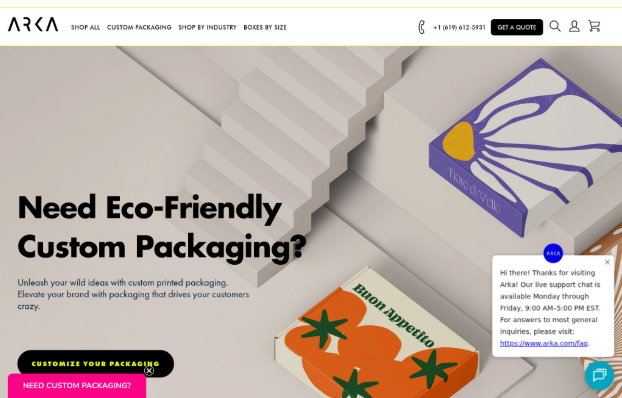
What Does Arka Do?
Arka is a San Francisco-based packaging manufacturer built for e-commerce and direct-to-consumer brands. They produce custom mailer boxes, shipping boxes, poly mailers, and folding cartons using FSC-certified recycled paper and compostable materials. What sets them apart early on is their 3D Design Studio paired with AI-driven inventory replenishment APIs that integrate seamlessly with major e-commerce platforms. That kind of tech connection is rare among packaging manufacturers, and it matters when you’re managing fast-moving inventory.
Why Arka Stands Out for Packaging Partners:
Arka addresses one of the most persistent problems for growing brands: getting low-minimum eco-friendly packaging without sacrificing customization or turnaround speed. Their AI-driven inventory API, paired with global fulfillment capabilities, ensures brands aren’t caught scrambling during peak-season order surges.
Summary of Real User Reviews:
Customers consistently point to Arka’s customer service responsiveness as a standout, with the founder personally stepping in during high-demand periods (that kind of accountability is rare). The quality of the unboxing experience is mentioned repeatedly, and turnaround times hold up well even on custom runs.
2. Packlane – Best for Custom Packaging Design and Printing
What Does Packlane Do?
Packlane is an online-first custom packaging platform founded in 2015, serving over 25,000 brands with printed mailer boxes, shipping boxes, and product boxes. Their real-time 3D design tool gives buyers instant price quotes as they adjust specs, removing much of the friction in the ordering process. Production turnaround runs at 10 days or less, with rush delivery available. They also use soy-based inks and recyclable materials, so the environmental responsibility piece isn’t an afterthought.
Why Packlane Stands Out for Packaging Partners:
Packlane solves the painful back-and-forth between design approval and production start by putting real-time visualization and instant pricing directly in the buyer’s hands. Brands like Everlane, Benefit Cosmetics, and L’Oreal have trusted them, which shows they’re capable at enterprise scale while still serving smaller accounts well.
Summary of Real User Reviews:
Honestly, the pattern that comes through most clearly is how much buyers appreciate the design tool’s simplicity and the speed of the production cycle. Fast turnaround on custom orders gets mentioned constantly. That usually means their pre-press and production workflow is genuinely tight.
3. Packola – Best for Custom Packaging for Small Businesses and Entrepreneurs
What Does Packola Do?
Packola is a California-based custom packaging provider focused on small businesses and entrepreneurs who need flexibility without a big upfront commitment. They produce product boxes, mailer boxes, shipping boxes, and custom labels with zero minimum order quantities, which is genuinely useful for brands still in their early scaling phase. Their US-based production keeps the carbon footprint lower than overseas alternatives, and every order goes through a design inspection to catch print-readiness issues before production starts (not a step you want to skip).
Why Packola Stands Out for Packaging Partners:
The zero-minimum policy removes the biggest barrier that holds back early-stage brands from getting professional-quality packaging. Their built-in design inspection layer catches file issues before ink hits paper, which keeps the defect rate low and the sample approval cycle clean.
Summary of Real User Reviews:
Packola has built a strong reputation with small and mid-sized businesses, with reviews highlighting site ease, customer service quality, and straightforward return accommodations. It’s the kind of experience that keeps independent brand owners coming back rather than hunting for another provider.
4. BoxUp – Best for Custom Packaging for Small Businesses and Ecommerce Brands
What Does BoxUp Do?
BoxUp is an Indiana-based manufacturer with deep roots in the paper industry, founded in 2008 by a third-generation paper professional. They operate from an 85,000-sq-ft facility, serve over 2,000 active clients across 48 states, and produce more than 50 million custom boxes annually. Minimum orders start at just 25 boxes, which keeps professional-grade packaging accessible to small accounts. BoxUp holds FSC Chain of Custody, ISO 9001, and ISO 14001 certifications, runs on 100% renewable energy, and maintains a defect rate below 0.5% (which is genuinely impressive given their production volume).
Why BoxUp Stands Out for Packaging Partners:
BoxUp handles the quality and environmental certifications that procurement managers at mid-market brands often require, while still keeping minimum order thresholds low enough for smaller operations to access. Their zero-waste-to-landfill commitment, backed by ISO 14001, gives buyers real documentation to support internal environmental reporting.
Summary of Real User Reviews:
Customers who’ve worked with BoxUp consistently mention the low minimums and fast turnaround as the main reasons they stay loyal. The 100% satisfaction guarantee backs up what the reviews already suggest: their quality standards hold across both small and large runs.
5. EcoEnclose – Best for Sustainable Ecommerce Packaging
What Does EcoEnclose Do?
EcoEnclose is a Colorado-based sustainable packaging manufacturer that makes mailers, shipping boxes, retail packaging, and protective supplies exclusively from 100% post-consumer recycled content with zero virgin plastics. They’ve served 25,000 customers, diverted 47 million pounds of waste from landfills, and achieved Climate Neutral Certification by offsetting 100% of carbon emissions. Their B Corporation certification score of 94.3 puts them in the top 10% globally (that’s enterprise-grade environmental credibility, not a marketing badge). For brands that need real environmental proof points for their own reporting, EcoEnclose is a serious option.
Why EcoEnclose Stands Out for Packaging Partners:
EcoEnclose solves the greenwashing problem that plagues many environmental claims in packaging by backing every material decision with verified certifications and measurable environmental data. That kind of documented accountability is rare in this space and matters when brand clients need FSC or Climate Neutral documentation for their own supply chain disclosures.
Summary of Real User Reviews:
EcoEnclose earns its B Corp score through demonstrated action, not just on paper. Customers cite the material quality and the environmental credibility as the main reasons for choosing them over standard providers. For brands where environmental responsibility is a central promise to their own customers, this is one of the more defensible choices in the market.
Research Methodology and Selection Process
The research behind this list was built around one question: which packaging partners can a brand actually rely on, not just in aspiration, but in production?
Initial Data Collection
The process began by compiling a broad list of packaging manufacturers and custom packaging platforms from industry directories, packaging-specific review platforms, and sourcing case studies of published brand partnerships. The goal at this stage was breadth, not filtering, so any provider with a meaningful online presence in the packaging manufacturing space was considered for the initial pool.
Shortlisting Phase
From there, the list was narrowed by removing providers with no verifiable client history, missing certifications, or review patterns that showed consistency issues. Companies relying on generic claims without documented operational specifics were filtered out. What remained were providers with enough public evidence to evaluate their actual capabilities, not just their marketing copy.
Verification of Claims
Every company’s stated strengths were cross-referenced against what customers actually reported. Where a company claimed fast turnaround, review patterns were checked for mentions of lead time performance. Where environmental certifications were listed, third-party verification sources were consulted. Claims without supporting evidence from multiple independent sources didn’t count toward the final ranking.
Authority and Industry Contribution Layer
Each shortlisted provider was then evaluated for broader industry standing. That included certification bodies like FSC, B Corp, ISO 9001, and ISO 14001, as well as mentions in packaging industry publications and partnerships with recognized consumer brands. A company’s presence in these contexts signals a level of operational credibility that goes beyond self-reported data.
Packaging Partners-Specific Evidence
The final filter looked at packaging manufacturing fit. Dedicated service pages covering structural engineering, print specifications, material sourcing, and order flexibility were weighted positively. Providers that demonstrated experience across regulated packaging categories, such as food contact compliance or pharmaceutical-grade materials, received additional consideration. The final list reflects companies that didn’t just serve packaging clients, but built their entire operation around packaging manufacturing outcomes.
How to Choose the Right Packaging Partners
The right packaging partner depends on what your brand actually needs, not what sounds impressive on a spec sheet. Here’s where to focus when evaluating options.
- Industry and Domain Experience: Look for partners with documented experience in your specific packaging category. Food, pharma, and hazardous materials require packaging standards that not every manufacturer handles.
- Features and Service Options: Confirm that design tooling, order minimums, structural options, and customization capabilities match your product requirements before going further in any conversation.
- Pricing Structure: Understand how the cost per unit changes at your likely order volumes. A low minimum order is useful early, but unit economics at scale matter more as you grow.
- Results Measurement: Ask about the on-time delivery rate, defect rate in parts per million, and sample approval cycle time. Partners who track these metrics openly are the ones worth trusting.
- Industry Knowledge and Compliance: Verify certifications directly. FSC, ISO 9001, and ISTA transit testing standards are not just credentials; they’re proof that a manufacturer has built quality into their process.
Bottom Line
Picking the right packaging partner comes down to matching their actual capabilities to where your brand is right now and where it’s heading. Environmental credentials, order flexibility, print quality, and technology solutions all carry real weight depending on your category. The five companies covered here each bring a distinct strength to the table. As brand expectations around packaging keep rising, working with a partner built for this space becomes less of an advantage and more of a baseline requirement.
This post may contain affiliate links.
More Recommended Ebike/Scooters
Check out these other ebikes and scooters I've reviewed:
- Urban Arrow Ebike – Last year, I made one of the largest purchases I’ve ever made – I bought a $9,000 electric cargo bike from Urban Arrow. In my Urban Arrow review, I will discuss what it is and why I decided to buy this bike, as well as discuss how impactful a bike like this can be on your journey to financial independence.
- Troxus Explorer Step-Thru Ebike – The Troxus Explorer Step-Thru is a fat-tire ebike that I’ve had the pleasure of riding for a while now. It has amazing power, great looks, and awesome range. If you’re looking for a great fat-tire ebike that offers a lot for the price, the Troxus Explorer Step-Thru is definitely one for you to consider. Check out my Troxus Explorer Step-Thru Review.
- Hovsco HovBeta Ebike – The HovBeta is a folding ebike with great specs and a lot of interesting features, and importantly, it’s sold at a good price point. I’ve had a blast commuting with it and using it to do deliveries with DoorDash, Uber Eats, and Grubhub. Check out my Hovsco HovBeta Ebike Review.
- Vanpowers Manidae Ebike – The Vanpowers Manidae is a fat tire ebike that I’ve been riding as my primary winter commuting bike and have also been using it to do food delivery with apps like DoorDash, Uber Eats, and Grubhub. After clocking in a decent number of miles with this ebike, I wanted to write a post sharing what my experience with the Vanpowers Manidae ebike has been like. Check out my Vanpowers Manidae Review.
- Sohamo S3 Step-Thru Folding EBike Review – A Great Value Folding Ebike – The Sohamo S3 Step-Thru Folding Ebike is an entry-level folding ebike that offers a lot of value for the price point. I’ve been riding the Sohamo S3 for a while now, putting the bike through its paces, and I have to say, this bike has exceeded all of my expectations. Check out my Sohamo Review.
- KBO Flip Ebike – The KBO Flip is an excellent bike. I’ve had a great time riding it and think it’s a versatile bike that can be used for a lot of purposes and can fit a variety of lifestyles. It’s worked out great for me as a general commuter bike and as a food delivery bike. Check out my KBO Flip Review.
- Hiboy P7 Commuter Ebike – The Hiboy P7 is an excellent electric commuter bike that’s offered at an affordable price point. The range and speed of this bike are both very good, so you won’t have any trouble getting anywhere you need to go with it. As a food delivery vehicle, this is also good – with how much range it offers, you’ll be able to work all day on a single charge. Check out my Hiboy P7 Commuter Electric Bike Review.
- Himiway Escape Ebike – The Himiway Escape is an interesting bike for anyone looking for a moped-style ebike. If you’re a gig economy worker, the Himiway Escape is particularly interesting and it’s possible to think of it as an investment, especially if you can opt to do deliveries with the Himiway versus using a car. It’s not cheap, but you can definitely make your money back when you compare the mileage you’ll put on your car versus using an ebike. Check out my Himiway Escape Bike Review.
- Espin Sport Ebike – The Espin Sport is a good ebike for someone who is looking for an ebike that feels and rides more like a regular bike. There are many ebikes that are really only bikes in name. In reality, they’re basically electric mopeds. The Espin Sport, by contrast, is a bike you could probably ride without the battery and you’d feel like you’re just riding a regular bike. Check out my Espin Sport Review.
- Varla Eagle One Scooter – The Varla Eagle One is an excellent scooter that can make sense for a lot of people. It can work as a primary mode of transportation. You can use it to work on gig economy apps like DoorDash, Uber Eats, and Grubhub. And it can also be a recreational vehicle if you’d prefer to use it for that. Check out my Varla Eagle One Review.
- Varla Falcon Scooter – The Varla Falcon is an excellent scooter that offers a good amount of power at a lower price point compared to more powerful scooters. It’s not exactly an entry-level scooter, nor is it a high-powered scooter. I think it fits somewhere in-between those two categories – an intermediate scooter if I had to give it a category. Check out my Varla Falcon Review.
- Hiboy S2 Scooter – The Hiboy S2 is an excellent entry-level commuter scooter that's perfect for someone looking to save some money in transportation costs and improve their commute. Check out my Hiboy S2 Review.
- Hiboy S2R Scooter – The Hiboy S2R is one of the more interesting electric scooters I’ve been able to test out. It’s not a high-powered scooter, but for an everyday transport option, it’s very useful, especially given some of the unique features that it has. Indeed, for the price, the Hiboy S2R might be the best value scooter I’ve used. Check out my Hiboy S2R Review.
- Fucare H3 Scooter – The Fucare H3 is a fun scooter and I’ve enjoyed testing it out. For a daily commuter or quick trips or errands, the Fucare H3 is probably the scooter I’ll use. It’s portable and easy to maneuver, so it’s just easier to take on the road when I need it. Check out my Fucare H3 Scooter Review.
More Recommended Investing App Bonuses
For additional investing app bonuses, be sure to check out the ones below:
- M1 Finance ($75) – This is a great robo-advisor that has no fees and allows you to create a customized portfolio based on your risk tolerance. You also get $75 for opening an account. Check out my M1 Finance Referral Bonus – Step-By-Step Guide.
- SoFi Invest ($25) – SoFi Invest is an easy brokerage account bonus that you can earn with just a few minutes of work. Use my SoFi Invest referral link, fund your SoFi Invest brokerage account with just $10 and you’ll get $25 of free stock. I also have a step-by-step guide for the SoFi Invest referral bonus.
- Robinhood (1 free stock) – Robinhood gives you a free stock valued between $2.50-$225 if you open an account using my referral link.
- Public (1 free stock) - Public gives you a free stock valued between $3-$70 if you open an account using my referral link.
More Recommended Bank Account Bonuses
If you’re looking for more easy bank bonuses, check out the below options. These bonuses are all easy to earn and have no fees or minimum balance requirements to worry about.
- Ally Bank ($100) – Of all the banks out there, Ally is, without a doubt, my favorite. At the moment, Ally is offering $100 to customers who open an eligible Ally account and meet the requirements. Here are the step-by-step directions to earn your Ally Bank referral bonus.
- Chime ($100) - Chime is a free bank account that offers a referral bonus if you use a referral link and complete a direct deposit of $200 or more. In practice, any ACH transfer into this account triggers the bonus. This bonus is easy to earn and posts instantly, so you’ll know if you met the requirements as soon as you move money into the account. I wrote a step-by-step guide on how to earn your Chime referral bonus that I recommend you check out.
- US Bank Business ($400/$1200) – This is a fairly easy bank bonus to earn, since there are no direct deposit requirements. In addition, you can open the Silver Business Checking account, which comes with no monthly fees. Check out how to earn this big bonus here.
- Current ($50) – Current is a free fintech bank that’s offering new users a $50 referral bonus after signing up for an account using a referral link. Current is an easy bonus to earn and also gives you access to three savings accounts that pay you 4% interest on up to $2,000. That means you can put away up to $6,000 earning 4% interest. That’s very good and makes Current an account I recommend to everyone. Check out my step-by-step guide on how to earn your Current Bank bonus.
- Novo Bank ($40) - Novo bank is a free business checking account that’s currently offering a $40 bonus if you open a Novo business checking account using a referral link. In addition to being a good bank bonus, Novo is also a good business checking account. It has no monthly fees or minimum balance requirements and operates a good app and website. Indeed, it’s the business checking account I currently use for this blog. Check out my post on how to easily open a Novo account.
- Varo ($25) – Varo is a free fintech banking app similar to Chime or Current. It’s currently offering a $25 bonus to new users that open a new Varo account with a referral link. The bonus for this bank is very easy to meet, all you need to do is spend $20 within 30 days of opening your Varo account. Check out my step-by-step guide to learn how to earn this bonus.

Kevin is an attorney and the blogger behind Financial Panther, a blog about personal finance, travel hacking, and side hustling using the gig economy. He paid off $87,000 worth of student loans in just 2.5 years by choosing not to live like a big shot lawyer.
Kevin is passionate about earning money using the gig economy and you can see all the ways he makes extra income every month in his side hustle reports.
Kevin is also big on using the latest fintech apps to improve his finances. Some of Kevin's favorite fintech apps include:
- SoFi Money. A really good checking account with absolutely no fees. You'll get a $25 referral bonus if you open a SoFi Money account with a referral link, and an additional $300 if you complete a direct deposit.
- 5% Savings Accounts. I'm currently getting 5.24% interest on my savings through a company called Raisin. Opening a Raisin account takes minutes to complete, it's free, and all of your funds are FDIC-insured. I explain how it works, why I'm now using it to store my emergency fund and any other cash savings I have, and why I recommend everyone check it out in this review.
- US Bank Business. US Bank is currently offering new business customers a $400/$1200 signup bonus after opening a new account and meeting certain requirements.
- M1 Finance. This is a great robo-advisor that has no fees and allows you to create a customized portfolio based on your risk tolerance. You also get $75 for opening an account.
- Empower. One of best free apps you can use to monitor your portfolio and track your net worth. This is one of the apps I use to track my financial accounts.
Feel free to send Kevin a message here.

Leave a Reply