Surviving a commercial collision initiates a chain reaction of financial liabilities that standard automobile policies simply do not cover. The immediate assumption centers on hospital bills and vehicle repairs, yet the true economic devastation emerges weeks later through hidden administrative and environmental costs.
When an eighteen-wheeler breaches a lane on Interstate 85, the resulting debris field often triggers municipal cleanup invoices directed at the involved parties before liability resolves. This operational reality forces individuals into a defensive financial posture while fighting for physical recovery.

The Financial Impact That Surfaces After the Hospital Stay
Commercial freight carriers operate under complex liability structures that inherently complicate financial recovery for collision victims. The bills accumulate rapidly. The period immediately following a crash introduces unexpected regulatory and environmental costs that catch families completely unprepared for the upcoming financial battle.
Cargo Spill Contamination and Environmental Liability
Freight manifests dictate the cleanup response required when a trailer ruptures during a collision. If a crash occurs near Buford Highway and releases hazardous materials, local authorities often dispatch specialized hazmat crews. Transportation incidents accounted for 34 percent of fatal work injuries in Georgia, frequently involving complex scenes that demand extensive mitigation.
Municipalities frequently issue initial mitigation invoices to all registered vehicle owners involved in the collision. Victims then face the burden of proving non-liability to dismiss these environmental cleanup fees. Reassigning this debt demands extensive documentation from the commercial carrier’s federally mandated pollution policy.
Federal Motor Carrier Penalties and Benefit Delays
Federal regulations mandate specific insurance minimums for commercial operators, which paradoxically slows down the disbursement of funds. National data show that 124,000 large truck and bus injury crashes occurred during a single year, generating massive bureaucratic backlogs across the insurance sector.
Fleet insurers notoriously delay medical payouts by launching multi-tiered investigations into driver logbooks and maintenance records. During this protracted evaluation period, injured individuals absorb the full cost of immediate rehabilitative care. Financial exhaustion provides a strategic advantage for the defense.
When the Insurance Structure Shifts the Burden to the Victim
Insurance adjusters handling commercial policies utilize specialized protocols designed to protect the corporate bottom line. These companies possess the resources to thoroughly scrutinize every medical procedure and property damage estimate. Retaining a Duluth truck accident lawyer, operating through the practice of Slam Dunk Attorney, a legal firm managing personal injury cases in Georgia, establishes a barrier against these aggressive reduction tactics.
The corporate defense strategy relies on shifting blame toward the injured party to activate comparative negligence statutes. “Insurance adjusters pull recorded statements within the first 48 hours specifically because injured people haven’t spoken to anyone yet, and those statements get used to contradict the claim months later,” says Duluth truck accident attorney Brian Wright. This manipulation limits initial settlement offers to a fraction of the actual incurred debt. The pressure mounts quickly.
Why Lost Wages Are Calculated Differently for Commercial Collisions
Standard automobile claims evaluate lost wages by multiplying missed days against recent pay stubs. Collisions involving heavy machinery cause severe physical trauma that permanently alters earning trajectories.
Evaluating this deficit requires vocational specialists to calculate lost future earning capacity based on changing market conditions. This projection must account for lost pension contributions and missed mandatory overtime. The transition period between careers generates a massive income gap that commercial insurers aggressively dispute.
The Hidden Cost of Specialized Medical Transport and Trauma Care
Severe impact forces dictate advanced medical intervention that local clinics cannot provide. Victims requiring Level I trauma care face high transport fees that standard health insurance restricts. Emergency transport from a crash site in Gwinnett County to a specialized surgical unit routinely generates five-figure invoices.
These out-of-network services bypass insurance pre-approval processes, leaving individuals personally responsible for the balance. Ongoing therapy and home modifications, like wheelchair ramps, create immediate out-of-pocket expenses long before liability settlements materialize.
How Secondary Household Expenses Compound Over Time
Severe physical limitations force households to outsource daily operations that the injured party managed independently. Childcare and basic home maintenance suddenly require paid contractors. These incremental expenses hide during initial claim valuations, and standard auto policies rarely compensate for these lifestyle modifications. If you are dealing with injuries from a commercial truck collision on Interstate 85 in Duluth, GA, securing your financial recovery is essential. Slam Dunk Attorney offers a free consultation to review your options. Call (678) 329-9750 to contact them or visit their legal team at 2250 Satellite Blvd, Ste. 120, just 12 minutes drive from Glancy Inpatient Rehabilitation Center, Duluth.
Federal data shows that 11,083,997 single-unit trucks maintain active national registration, representing massive exposure for daily commuters. Over a multi-year recovery, minor weekly charges accumulate into substantial financial deficits. Documenting these losses requires meticulous record-keeping and a clear demonstration of medical necessity.
Why Subrogation Liens Intercept Final Settlement Payouts
Health insurance providers maintain subrogation rights to recover trauma care costs from final settlements. If an injured party receives treatment at Northside Hospital Gwinnett, the facility files a lien directly against the pending legal claim under Georgia law. Likewise, if the patient uses Medicare or Medicaid, those federal healthcare programs enforce strict recovery protocols that supersede state protections.
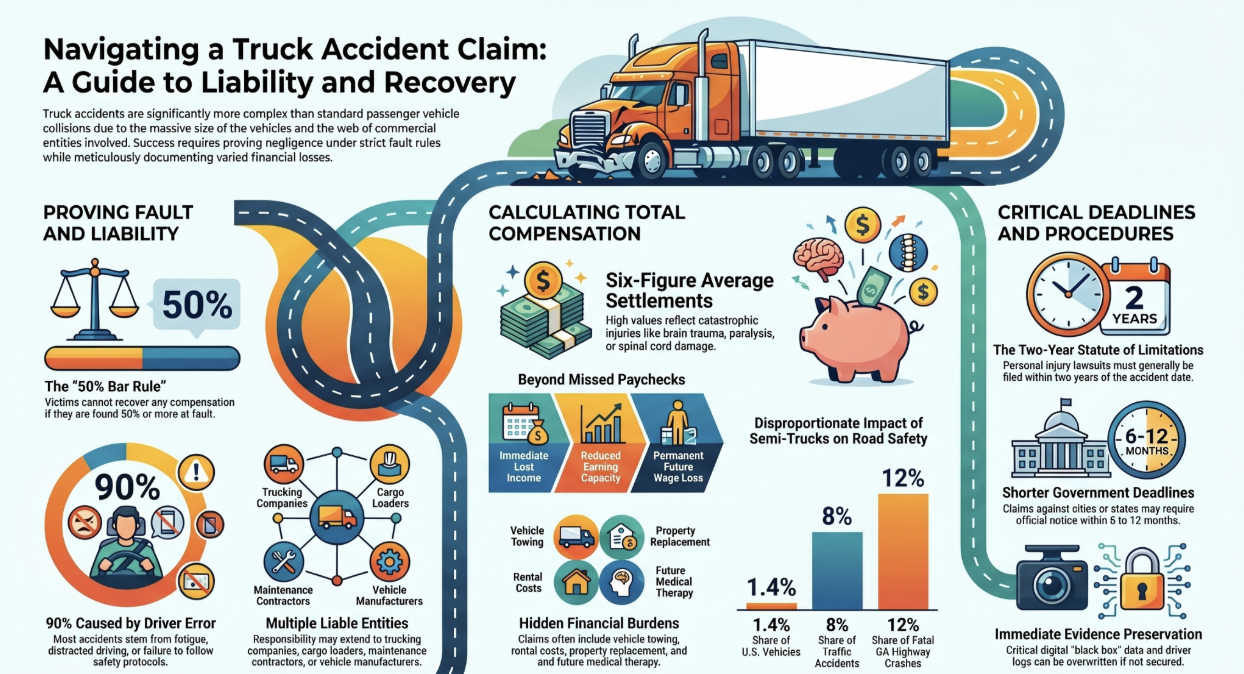
National safety data shows large trucks accounted for 10 percent of nationwide miles traveled, correlating with severe impacts that trigger these complex medical liens. Resolving these statutory claims requires strategic negotiation to prevent drastic payout reductions.
Questions About Georgia Truck Accident Burdens
How do commercial insurance limits affect out-of-pocket medical costs?
Commercial policies carry higher limits, but the insurers freeze initial payouts during liability investigations. This delay forces victims to use personal health insurance or pay cash for immediate care, generating massive out-of-pocket deductibles until the corporate policy finally issues a reimbursement.
What role do federal regulations play in the settlement timeline?
Federal guidelines require extensive data preservation, including electronic logging device records and maintenance history. Gathering and analyzing this mandatory data significantly extends the investigative phase, which delays settlement negotiations and forces victims to float their own financial obligations much longer.
Why do municipal cleanup bills target the victims of commercial crashes?
Local authorities automatically bill all involved parties to quickly recoup the costs of clearing debris or hazardous spills from public roadways. The injured party must actively dispute these invoices by proving the commercial driver caused the spill, temporarily placing the financial liability on the victim. The delay causes hardship.
This content is for informational purposes only and does not constitute legal advice. Readers should consult a licensed attorney for guidance specific to their situation.
This post may contain affiliate links.
More Recommended Ebike/Scooters
Check out these other ebikes and scooters I've reviewed:
- Urban Arrow Ebike – Last year, I made one of the largest purchases I’ve ever made – I bought a $9,000 electric cargo bike from Urban Arrow. In my Urban Arrow review, I will discuss what it is and why I decided to buy this bike, as well as discuss how impactful a bike like this can be on your journey to financial independence.
- Troxus Explorer Step-Thru Ebike – The Troxus Explorer Step-Thru is a fat-tire ebike that I’ve had the pleasure of riding for a while now. It has amazing power, great looks, and awesome range. If you’re looking for a great fat-tire ebike that offers a lot for the price, the Troxus Explorer Step-Thru is definitely one for you to consider. Check out my Troxus Explorer Step-Thru Review.
- Hovsco HovBeta Ebike – The HovBeta is a folding ebike with great specs and a lot of interesting features, and importantly, it’s sold at a good price point. I’ve had a blast commuting with it and using it to do deliveries with DoorDash, Uber Eats, and Grubhub. Check out my Hovsco HovBeta Ebike Review.
- Vanpowers Manidae Ebike – The Vanpowers Manidae is a fat tire ebike that I’ve been riding as my primary winter commuting bike and have also been using it to do food delivery with apps like DoorDash, Uber Eats, and Grubhub. After clocking in a decent number of miles with this ebike, I wanted to write a post sharing what my experience with the Vanpowers Manidae ebike has been like. Check out my Vanpowers Manidae Review.
- Sohamo S3 Step-Thru Folding EBike Review – A Great Value Folding Ebike – The Sohamo S3 Step-Thru Folding Ebike is an entry-level folding ebike that offers a lot of value for the price point. I’ve been riding the Sohamo S3 for a while now, putting the bike through its paces, and I have to say, this bike has exceeded all of my expectations. Check out my Sohamo Review.
- KBO Flip Ebike – The KBO Flip is an excellent bike. I’ve had a great time riding it and think it’s a versatile bike that can be used for a lot of purposes and can fit a variety of lifestyles. It’s worked out great for me as a general commuter bike and as a food delivery bike. Check out my KBO Flip Review.
- Hiboy P7 Commuter Ebike – The Hiboy P7 is an excellent electric commuter bike that’s offered at an affordable price point. The range and speed of this bike are both very good, so you won’t have any trouble getting anywhere you need to go with it. As a food delivery vehicle, this is also good – with how much range it offers, you’ll be able to work all day on a single charge. Check out my Hiboy P7 Commuter Electric Bike Review.
- Himiway Escape Ebike – The Himiway Escape is an interesting bike for anyone looking for a moped-style ebike. If you’re a gig economy worker, the Himiway Escape is particularly interesting and it’s possible to think of it as an investment, especially if you can opt to do deliveries with the Himiway versus using a car. It’s not cheap, but you can definitely make your money back when you compare the mileage you’ll put on your car versus using an ebike. Check out my Himiway Escape Bike Review.
- Espin Sport Ebike – The Espin Sport is a good ebike for someone who is looking for an ebike that feels and rides more like a regular bike. There are many ebikes that are really only bikes in name. In reality, they’re basically electric mopeds. The Espin Sport, by contrast, is a bike you could probably ride without the battery and you’d feel like you’re just riding a regular bike. Check out my Espin Sport Review.
- Varla Eagle One Scooter – The Varla Eagle One is an excellent scooter that can make sense for a lot of people. It can work as a primary mode of transportation. You can use it to work on gig economy apps like DoorDash, Uber Eats, and Grubhub. And it can also be a recreational vehicle if you’d prefer to use it for that. Check out my Varla Eagle One Review.
- Varla Falcon Scooter – The Varla Falcon is an excellent scooter that offers a good amount of power at a lower price point compared to more powerful scooters. It’s not exactly an entry-level scooter, nor is it a high-powered scooter. I think it fits somewhere in-between those two categories – an intermediate scooter if I had to give it a category. Check out my Varla Falcon Review.
- Hiboy S2 Scooter – The Hiboy S2 is an excellent entry-level commuter scooter that's perfect for someone looking to save some money in transportation costs and improve their commute. Check out my Hiboy S2 Review.
- Hiboy S2R Scooter – The Hiboy S2R is one of the more interesting electric scooters I’ve been able to test out. It’s not a high-powered scooter, but for an everyday transport option, it’s very useful, especially given some of the unique features that it has. Indeed, for the price, the Hiboy S2R might be the best value scooter I’ve used. Check out my Hiboy S2R Review.
- Fucare H3 Scooter – The Fucare H3 is a fun scooter and I’ve enjoyed testing it out. For a daily commuter or quick trips or errands, the Fucare H3 is probably the scooter I’ll use. It’s portable and easy to maneuver, so it’s just easier to take on the road when I need it. Check out my Fucare H3 Scooter Review.
More Recommended Investing App Bonuses
For additional investing app bonuses, be sure to check out the ones below:
- M1 Finance ($75) – This is a great robo-advisor that has no fees and allows you to create a customized portfolio based on your risk tolerance. You also get $75 for opening an account. Check out my M1 Finance Referral Bonus – Step-By-Step Guide.
- SoFi Invest ($25) – SoFi Invest is an easy brokerage account bonus that you can earn with just a few minutes of work. Use my SoFi Invest referral link, fund your SoFi Invest brokerage account with just $10 and you’ll get $25 of free stock. I also have a step-by-step guide for the SoFi Invest referral bonus.
- Robinhood (1 free stock) – Robinhood gives you a free stock valued between $2.50-$225 if you open an account using my referral link.
- Public (1 free stock) - Public gives you a free stock valued between $3-$70 if you open an account using my referral link.
More Recommended Bank Account Bonuses
If you’re looking for more easy bank bonuses, check out the below options. These bonuses are all easy to earn and have no fees or minimum balance requirements to worry about.
- Ally Bank ($100) – Of all the banks out there, Ally is, without a doubt, my favorite. At the moment, Ally is offering $100 to customers who open an eligible Ally account and meet the requirements. Here are the step-by-step directions to earn your Ally Bank referral bonus.
- Chime ($100) - Chime is a free bank account that offers a referral bonus if you use a referral link and complete a direct deposit of $200 or more. In practice, any ACH transfer into this account triggers the bonus. This bonus is easy to earn and posts instantly, so you’ll know if you met the requirements as soon as you move money into the account. I wrote a step-by-step guide on how to earn your Chime referral bonus that I recommend you check out.
- US Bank Business ($400/$1200) – This is a fairly easy bank bonus to earn, since there are no direct deposit requirements. In addition, you can open the Silver Business Checking account, which comes with no monthly fees. Check out how to earn this big bonus here.
- Current ($50) – Current is a free fintech bank that’s offering new users a $50 referral bonus after signing up for an account using a referral link. Current is an easy bonus to earn and also gives you access to three savings accounts that pay you 4% interest on up to $2,000. That means you can put away up to $6,000 earning 4% interest. That’s very good and makes Current an account I recommend to everyone. Check out my step-by-step guide on how to earn your Current Bank bonus.
- Novo Bank ($40) - Novo bank is a free business checking account that’s currently offering a $40 bonus if you open a Novo business checking account using a referral link. In addition to being a good bank bonus, Novo is also a good business checking account. It has no monthly fees or minimum balance requirements and operates a good app and website. Indeed, it’s the business checking account I currently use for this blog. Check out my post on how to easily open a Novo account.
- Varo ($25) – Varo is a free fintech banking app similar to Chime or Current. It’s currently offering a $25 bonus to new users that open a new Varo account with a referral link. The bonus for this bank is very easy to meet, all you need to do is spend $20 within 30 days of opening your Varo account. Check out my step-by-step guide to learn how to earn this bonus.

Kevin is an attorney and the blogger behind Financial Panther, a blog about personal finance, travel hacking, and side hustling using the gig economy. He paid off $87,000 worth of student loans in just 2.5 years by choosing not to live like a big shot lawyer.
Kevin is passionate about earning money using the gig economy and you can see all the ways he makes extra income every month in his side hustle reports.
Kevin is also big on using the latest fintech apps to improve his finances. Some of Kevin's favorite fintech apps include:
- SoFi Money. A really good checking account with absolutely no fees. You'll get a $25 referral bonus if you open a SoFi Money account with a referral link, and an additional $300 if you complete a direct deposit.
- 5% Savings Accounts. I'm currently getting 5.24% interest on my savings through a company called Raisin. Opening a Raisin account takes minutes to complete, it's free, and all of your funds are FDIC-insured. I explain how it works, why I'm now using it to store my emergency fund and any other cash savings I have, and why I recommend everyone check it out in this review.
- US Bank Business. US Bank is currently offering new business customers a $400/$1200 signup bonus after opening a new account and meeting certain requirements.
- M1 Finance. This is a great robo-advisor that has no fees and allows you to create a customized portfolio based on your risk tolerance. You also get $75 for opening an account.
- Empower. One of best free apps you can use to monitor your portfolio and track your net worth. This is one of the apps I use to track my financial accounts.
Feel free to send Kevin a message here.

Leave a Reply