I get asked some version of this question a lot: where should a first-time investor actually buy? My answer lately has been North Carolina, not because it’s trendy, but because the fundamentals line up in a way that’s genuinely rare.
Most states have one or two things going for them. Maybe the population is growing, but prices are already too high. Maybe prices are low, but nobody wants to live there.
North Carolina checks almost every box at once, and it’s done so for years, not months. Let’s see why!

Why the State Keeps Showing Up on Every Investor’s List
People keep moving to North Carolina, and that fact alone drives most of the investing conversation around the state. It added more than half a million residents between 2020 and 2025, and most of that came from people relocating from other states rather than from births outnumbering deaths. That distinction matters more than it sounds like it should.
Natural population growth is slow and predictable. Migration shows up in waves, driven by people actively choosing a place over somewhere else. Working adults with steady paychecks need housing fast when they relocate.
They rent while figuring out where to buy, or because buying isn’t in the cards yet. Either way, that’s demand landing directly on your portfolio if you already own something there.
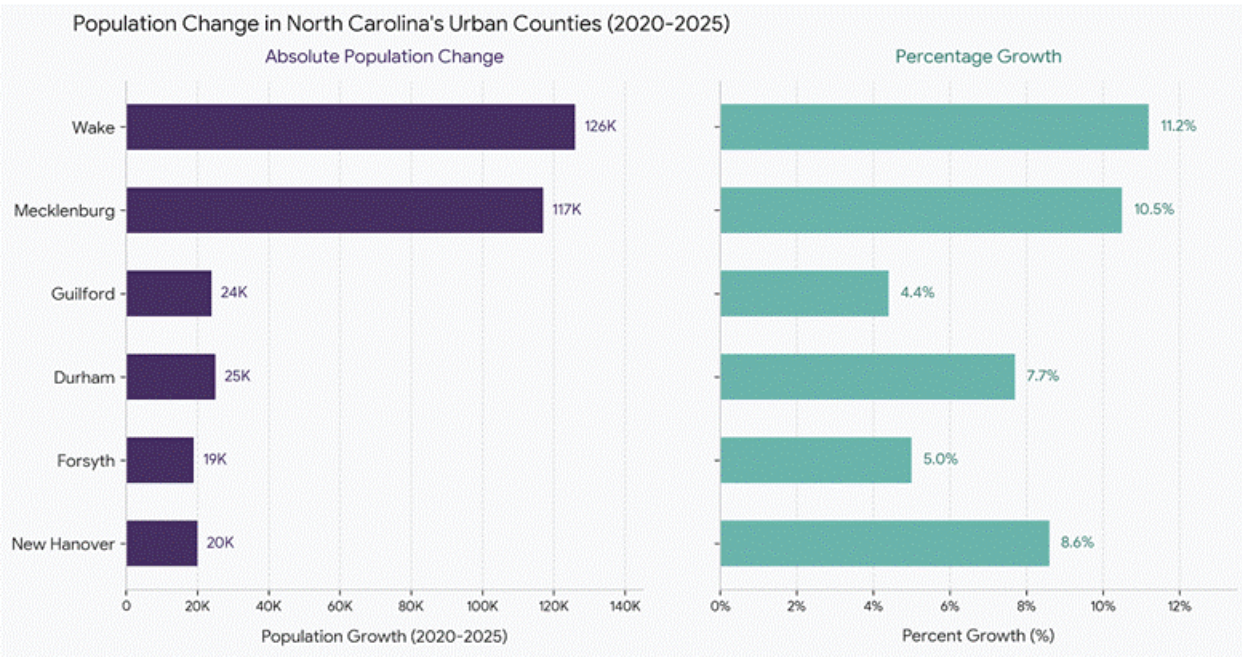
I’ve watched cities go through this pattern before, usually followed by a multi-year run where rents climb faster than expenses. North Carolina isn’t guessing at this. It’s already happening, concentrated around Raleigh, Charlotte, and a handful of coastal counties that keep popping up on national growth rankings.
This is exactly the setup that experienced real estate investing North Carolina portfolios have been built around: buying growth corridors before the broader market catches on.
The Price Gap Nobody Talks About Enough
Here’s the part that gets me excited, though. A lot of fast-growing states already priced out the average investor years ago. Try buying a rental in Austin or Nashville today, and you’ll see what I mean. North Carolina hasn’t fully caught up to its own growth story yet, and that gap is where the opportunity sits.
You can still find single-family homes and small multifamily properties in solid, growing submarkets at prices that make the math work on paper. That’s not something I can say about most states showing this kind of migration trend. Usually by the time the population numbers get attention, prices have already run ahead of them.
What Actually Makes a Good First Rental Market
I always tell first-time investors the same thing. Don’t chase the market with the best headline. Chase the one with the best combination of boring, reliable factors, and North Carolina fits that description better than most.
Job diversity is one piece of it. The state isn’t leaning on a single industry the way some boom towns do. There’s healthcare, banking and finance in Charlotte, tech jobs around the Triangle, and a growing logistics sector tied to the ports. When one sector slows, the local economy doesn’t stall with it, and that protects rental demand exactly when a first-time landlord needs it most.
Landlord-tenant law is another factor people underrate until they’ve dealt with a bad tenant situation elsewhere. North Carolina’s eviction process and lease enforcement rules are considered workable and reasonably balanced, rather than stacked heavily toward tenant protections at the landlord’s expense.
Property taxes help the math too. Compared to high-tax states in the Northeast or parts of the Midwest, North Carolina’s rates are moderate, and that difference compounds every year you hold the property.
Where to Actually Look
Not every corner of the state deserves your money. Rural counties in the northeast have been losing population for years, and buying there is a different bet entirely, one built on low prices rather than growth.
Focus on counties absorbing the bulk of the migration. Wake and Mecklenburg keep landing near the top of national growth rankings, while suburban counties around them, places like Johnston, Iredell, and Franklin, pick up overflow as those metros get pricier.
Coastal counties like Brunswick have also drawn steady attention, from retirees and remote workers wanting space without giving up proximity to the water.
If I were starting from zero today, I’d search in a suburban county just outside Raleigh or Charlotte rather than the urban core. Prices stay more reasonable, commutes remain workable, and growth in these secondary markets often outpaces the already-established center.
Is It Actually Worth It?
For a first-time investor, yes, North Carolina makes a genuinely strong case. The population trend is real and well-documented, prices haven’t fully caught up to it, the landlord environment is workable, and the economy isn’t dependent on one industry.
That said, none of this replaces doing your own homework on a specific property and neighborhood. Growth trends tell you where to start looking, not which house to buy.
Walk the neighborhood, check local vacancy rates, and talk to a property manager who already works in that county before you commit.
The state gives you a strong foundation, but the details of the individual deal still decide whether it actually makes you money.
This post may contain affiliate links.
More Recommended Ebike/Scooters
Check out these other ebikes and scooters I've reviewed:
- Urban Arrow Ebike – Last year, I made one of the largest purchases I’ve ever made – I bought a $9,000 electric cargo bike from Urban Arrow. In my Urban Arrow review, I will discuss what it is and why I decided to buy this bike, as well as discuss how impactful a bike like this can be on your journey to financial independence.
- Troxus Explorer Step-Thru Ebike – The Troxus Explorer Step-Thru is a fat-tire ebike that I’ve had the pleasure of riding for a while now. It has amazing power, great looks, and awesome range. If you’re looking for a great fat-tire ebike that offers a lot for the price, the Troxus Explorer Step-Thru is definitely one for you to consider. Check out my Troxus Explorer Step-Thru Review.
- Hovsco HovBeta Ebike – The HovBeta is a folding ebike with great specs and a lot of interesting features, and importantly, it’s sold at a good price point. I’ve had a blast commuting with it and using it to do deliveries with DoorDash, Uber Eats, and Grubhub. Check out my Hovsco HovBeta Ebike Review.
- Vanpowers Manidae Ebike – The Vanpowers Manidae is a fat tire ebike that I’ve been riding as my primary winter commuting bike and have also been using it to do food delivery with apps like DoorDash, Uber Eats, and Grubhub. After clocking in a decent number of miles with this ebike, I wanted to write a post sharing what my experience with the Vanpowers Manidae ebike has been like. Check out my Vanpowers Manidae Review.
- Sohamo S3 Step-Thru Folding EBike Review – A Great Value Folding Ebike – The Sohamo S3 Step-Thru Folding Ebike is an entry-level folding ebike that offers a lot of value for the price point. I’ve been riding the Sohamo S3 for a while now, putting the bike through its paces, and I have to say, this bike has exceeded all of my expectations. Check out my Sohamo Review.
- KBO Flip Ebike – The KBO Flip is an excellent bike. I’ve had a great time riding it and think it’s a versatile bike that can be used for a lot of purposes and can fit a variety of lifestyles. It’s worked out great for me as a general commuter bike and as a food delivery bike. Check out my KBO Flip Review.
- Hiboy P7 Commuter Ebike – The Hiboy P7 is an excellent electric commuter bike that’s offered at an affordable price point. The range and speed of this bike are both very good, so you won’t have any trouble getting anywhere you need to go with it. As a food delivery vehicle, this is also good – with how much range it offers, you’ll be able to work all day on a single charge. Check out my Hiboy P7 Commuter Electric Bike Review.
- Himiway Escape Ebike – The Himiway Escape is an interesting bike for anyone looking for a moped-style ebike. If you’re a gig economy worker, the Himiway Escape is particularly interesting and it’s possible to think of it as an investment, especially if you can opt to do deliveries with the Himiway versus using a car. It’s not cheap, but you can definitely make your money back when you compare the mileage you’ll put on your car versus using an ebike. Check out my Himiway Escape Bike Review.
- Espin Sport Ebike – The Espin Sport is a good ebike for someone who is looking for an ebike that feels and rides more like a regular bike. There are many ebikes that are really only bikes in name. In reality, they’re basically electric mopeds. The Espin Sport, by contrast, is a bike you could probably ride without the battery and you’d feel like you’re just riding a regular bike. Check out my Espin Sport Review.
- Varla Eagle One Scooter – The Varla Eagle One is an excellent scooter that can make sense for a lot of people. It can work as a primary mode of transportation. You can use it to work on gig economy apps like DoorDash, Uber Eats, and Grubhub. And it can also be a recreational vehicle if you’d prefer to use it for that. Check out my Varla Eagle One Review.
- Varla Falcon Scooter – The Varla Falcon is an excellent scooter that offers a good amount of power at a lower price point compared to more powerful scooters. It’s not exactly an entry-level scooter, nor is it a high-powered scooter. I think it fits somewhere in-between those two categories – an intermediate scooter if I had to give it a category. Check out my Varla Falcon Review.
- Hiboy S2 Scooter – The Hiboy S2 is an excellent entry-level commuter scooter that's perfect for someone looking to save some money in transportation costs and improve their commute. Check out my Hiboy S2 Review.
- Hiboy S2R Scooter – The Hiboy S2R is one of the more interesting electric scooters I’ve been able to test out. It’s not a high-powered scooter, but for an everyday transport option, it’s very useful, especially given some of the unique features that it has. Indeed, for the price, the Hiboy S2R might be the best value scooter I’ve used. Check out my Hiboy S2R Review.
- Fucare H3 Scooter – The Fucare H3 is a fun scooter and I’ve enjoyed testing it out. For a daily commuter or quick trips or errands, the Fucare H3 is probably the scooter I’ll use. It’s portable and easy to maneuver, so it’s just easier to take on the road when I need it. Check out my Fucare H3 Scooter Review.
More Recommended Investing App Bonuses
For additional investing app bonuses, be sure to check out the ones below:
- M1 Finance ($75) – This is a great robo-advisor that has no fees and allows you to create a customized portfolio based on your risk tolerance. You also get $75 for opening an account. Check out my M1 Finance Referral Bonus – Step-By-Step Guide.
- SoFi Invest ($25) – SoFi Invest is an easy brokerage account bonus that you can earn with just a few minutes of work. Use my SoFi Invest referral link, fund your SoFi Invest brokerage account with just $10 and you’ll get $25 of free stock. I also have a step-by-step guide for the SoFi Invest referral bonus.
- Robinhood (1 free stock) – Robinhood gives you a free stock valued between $2.50-$225 if you open an account using my referral link.
- Public (1 free stock) - Public gives you a free stock valued between $3-$70 if you open an account using my referral link.
More Recommended Bank Account Bonuses
If you’re looking for more easy bank bonuses, check out the below options. These bonuses are all easy to earn and have no fees or minimum balance requirements to worry about.
- Ally Bank ($100) – Of all the banks out there, Ally is, without a doubt, my favorite. At the moment, Ally is offering $100 to customers who open an eligible Ally account and meet the requirements. Here are the step-by-step directions to earn your Ally Bank referral bonus.
- Chime ($100) - Chime is a free bank account that offers a referral bonus if you use a referral link and complete a direct deposit of $200 or more. In practice, any ACH transfer into this account triggers the bonus. This bonus is easy to earn and posts instantly, so you’ll know if you met the requirements as soon as you move money into the account. I wrote a step-by-step guide on how to earn your Chime referral bonus that I recommend you check out.
- US Bank Business ($400/$1200) – This is a fairly easy bank bonus to earn, since there are no direct deposit requirements. In addition, you can open the Silver Business Checking account, which comes with no monthly fees. Check out how to earn this big bonus here.
- Current ($50) – Current is a free fintech bank that’s offering new users a $50 referral bonus after signing up for an account using a referral link. Current is an easy bonus to earn and also gives you access to three savings accounts that pay you 4% interest on up to $2,000. That means you can put away up to $6,000 earning 4% interest. That’s very good and makes Current an account I recommend to everyone. Check out my step-by-step guide on how to earn your Current Bank bonus.
- Novo Bank ($40) - Novo bank is a free business checking account that’s currently offering a $40 bonus if you open a Novo business checking account using a referral link. In addition to being a good bank bonus, Novo is also a good business checking account. It has no monthly fees or minimum balance requirements and operates a good app and website. Indeed, it’s the business checking account I currently use for this blog. Check out my post on how to easily open a Novo account.
- Varo ($25) – Varo is a free fintech banking app similar to Chime or Current. It’s currently offering a $25 bonus to new users that open a new Varo account with a referral link. The bonus for this bank is very easy to meet, all you need to do is spend $20 within 30 days of opening your Varo account. Check out my step-by-step guide to learn how to earn this bonus.

Kevin is an attorney and the blogger behind Financial Panther, a blog about personal finance, travel hacking, and side hustling using the gig economy. He paid off $87,000 worth of student loans in just 2.5 years by choosing not to live like a big shot lawyer.
Kevin is passionate about earning money using the gig economy and you can see all the ways he makes extra income every month in his side hustle reports.
Kevin is also big on using the latest fintech apps to improve his finances. Some of Kevin's favorite fintech apps include:
- SoFi Money. A really good checking account with absolutely no fees. You'll get a $25 referral bonus if you open a SoFi Money account with a referral link, and an additional $300 if you complete a direct deposit.
- 5% Savings Accounts. I'm currently getting 5.24% interest on my savings through a company called Raisin. Opening a Raisin account takes minutes to complete, it's free, and all of your funds are FDIC-insured. I explain how it works, why I'm now using it to store my emergency fund and any other cash savings I have, and why I recommend everyone check it out in this review.
- US Bank Business. US Bank is currently offering new business customers a $400/$1200 signup bonus after opening a new account and meeting certain requirements.
- M1 Finance. This is a great robo-advisor that has no fees and allows you to create a customized portfolio based on your risk tolerance. You also get $75 for opening an account.
- Empower. One of best free apps you can use to monitor your portfolio and track your net worth. This is one of the apps I use to track my financial accounts.
Feel free to send Kevin a message here.

Leave a Reply