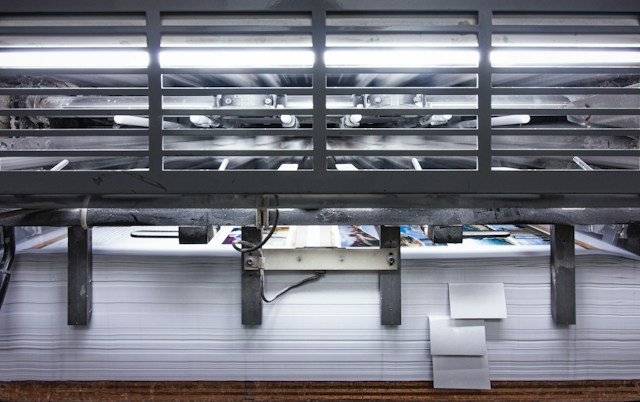
Vistaprint earned its place as the default for small print orders. The templates are easy, the prices are posted up front, and the cards show up at your door a few days later. Its parent company, Cimpress, is a giant of the online print business, and Vistaprint’s revenue was still growing as Cimpress opened its 2026 fiscal year. For a solo consultant who needs 500 business cards, it is hard to beat.
The reasons people move on are usually specific. One is that nobody looks at your file before it prints: you approve an on-screen proof, and if the color shifts or a line of type sits too close to the trim, you find out when the box arrives. A request that keeps surfacing in customer reviews is for a service that checks the project before it goes to press. The other is scope. Once an order involves thousands of mailers, a dozen people ordering on one account, or materials that need to be stored and shipped later, a template site stops being the right tool.
If you are in St. Louis and have hit either wall, the short answer is that Modern Litho is the strongest alternative for large printed volume and mail, Stolze Printing is the better call for mid-size offset jobs where you want a local press, and several others cover narrower needs. We have organized them by the reason you are leaving.
Why print still deserves the extra effort
Moving from a template site to a commercial printer takes more of your time, so it is fair to ask whether print is worth it. The latest Two Sides Trend Tracker, a survey of 12,400 consumers across several countries, found European preference for printed catalogs and magazines climbing back since 2021, and three-quarters of respondents backed the right to choose paper over digital for communications. Readers still treat a well-made printed piece as more credible, which is the whole reason to get it right.
1. If you’ve outgrown Vistaprint on volume: Modern Litho
Modern Litho is a Jefferson City company with facilities in Columbia, Kansas City and St. Louis as well, and its St. Louis operation on The Hill has grown fast. When it first moved to Southwest Avenue in 2018, Printing Impressions reported the expansion into direct mail, large format, on-site storage and fulfillment; by late 2023 it had moved again, a short distance down the same street, into a building with more than double the production space.
What changes when you switch: you get catalog and publication printing, die-cutting, pocket folders and in-house mailing, which makes it a natural step up for anyone mailing tens of thousands of pieces.
What you give up: instant online pricing. Expect a quote and a conversation, not a shopping cart.
2. If you want a real press check on mid-size runs: Stolze Printing
Stolze started in 1984 when Philip Stolze opened a duplicator shop in his basement after his employer, a web printer, left St. Louis. It has since grown into one of the larger independent shops in the city, running offset and digital presses and handling direct mail.
What changes: a person at a local plant reviews your files, and you can ask for a hard-copy proof before the run. University purchasing staff note that Stolze’s pricing is sharpest on longer press runs.
What you give up: on a run of 250 cards, a local offset shop will rarely beat Vistaprint’s posted price.
3. If you’re ordering for a whole team or sending personalized pieces: Repco Solutions
This is the switch that comes up when a company’s print orders stop being one person’s job. Sales reps in five cities each need their own business cards and leave-behinds. HR needs onboarding folders on demand. Marketing wants a mailer where each recipient sees their own name worked into the image itself, not just the address block.
Repco Solutions, a St. Louis County printer that has been in business since 1966, builds custom e-stores for exactly that situation: a private web store where employees, a sales force or dealers order approved materials, with administration and reporting handled for the client and items printed on demand rather than stored by the pallet. It pairs that with variable data printing that can personalize the image as well as the text, combining customer data with imagery to produce one-off pieces in a single run. Its own warehouse and kitting operation sit behind the store, so stocked items can ship from the same building.
What changes: brand control and a single bill instead of a dozen employee credit card orders. What you give up: the e-store is a custom build, not a sign-up form, and Repco doesn’t publish prices. For a one-person business that only needs cards twice a year, it is more setup than the job needs.
4. If you manage a brand across many locations: RBO PrintLogistix
RBO, headquartered in Maryland Heights, approaches print as brand management. Its offering centers on web-to-print ordering, digital asset management and promotional sourcing for hundreds of clients, and a 2022 acquisition in suburban Chicago extended its reach outside Missouri.
What changes: tight control over who can order what, with asset libraries that keep franchisees or regional offices on brand.
What you give up: RBO’s in-house production is digital, with offset work sent to partner plants, so very long runs pass through another shop.
5. If you liked the speed and just want it today: Minuteman Press
Some people leave Vistaprint for the opposite reason: shipping takes too long. Minuteman Press franchise locations around the region, including one in St. Peters, offer counter service and quick-turn digital printing.
What changes: local pickup instead of waiting on a parcel, and someone to talk to at the counter.
What you give up: franchise locations vary in equipment and staff, so quality depends on the specific shop.
Who should stay with Vistaprint
If your orders are small, standard and infrequent, there is little reason to switch. Freelancers, new businesses testing a logo, and anyone printing a few hundred cards or a single banner will get good value from a template site, and many customers report perfectly good results. Vistaprint also makes sense as a backup for simple reorders even after you move bigger work to a local commercial printer.
Making the move
Whichever St. Louis print shop you choose, bring the same three things to the first call: your print-ready files (or a request for help preparing them), realistic quantities for the next twelve months rather than just this order, and a clear answer on whether anything needs to be stored or shipped afterward. Those details decide which of these printers is the right fit far more than the per-piece price on any single job.
This post may contain affiliate links.
More Recommended Ebike/Scooters
Check out these other ebikes and scooters I've reviewed:
- Urban Arrow Ebike – Last year, I made one of the largest purchases I’ve ever made – I bought a $9,000 electric cargo bike from Urban Arrow. In my Urban Arrow review, I will discuss what it is and why I decided to buy this bike, as well as discuss how impactful a bike like this can be on your journey to financial independence.
- Troxus Explorer Step-Thru Ebike – The Troxus Explorer Step-Thru is a fat-tire ebike that I’ve had the pleasure of riding for a while now. It has amazing power, great looks, and awesome range. If you’re looking for a great fat-tire ebike that offers a lot for the price, the Troxus Explorer Step-Thru is definitely one for you to consider. Check out my Troxus Explorer Step-Thru Review.
- Hovsco HovBeta Ebike – The HovBeta is a folding ebike with great specs and a lot of interesting features, and importantly, it’s sold at a good price point. I’ve had a blast commuting with it and using it to do deliveries with DoorDash, Uber Eats, and Grubhub. Check out my Hovsco HovBeta Ebike Review.
- Vanpowers Manidae Ebike – The Vanpowers Manidae is a fat tire ebike that I’ve been riding as my primary winter commuting bike and have also been using it to do food delivery with apps like DoorDash, Uber Eats, and Grubhub. After clocking in a decent number of miles with this ebike, I wanted to write a post sharing what my experience with the Vanpowers Manidae ebike has been like. Check out my Vanpowers Manidae Review.
- Sohamo S3 Step-Thru Folding EBike Review – A Great Value Folding Ebike – The Sohamo S3 Step-Thru Folding Ebike is an entry-level folding ebike that offers a lot of value for the price point. I’ve been riding the Sohamo S3 for a while now, putting the bike through its paces, and I have to say, this bike has exceeded all of my expectations. Check out my Sohamo Review.
- KBO Flip Ebike – The KBO Flip is an excellent bike. I’ve had a great time riding it and think it’s a versatile bike that can be used for a lot of purposes and can fit a variety of lifestyles. It’s worked out great for me as a general commuter bike and as a food delivery bike. Check out my KBO Flip Review.
- Hiboy P7 Commuter Ebike – The Hiboy P7 is an excellent electric commuter bike that’s offered at an affordable price point. The range and speed of this bike are both very good, so you won’t have any trouble getting anywhere you need to go with it. As a food delivery vehicle, this is also good – with how much range it offers, you’ll be able to work all day on a single charge. Check out my Hiboy P7 Commuter Electric Bike Review.
- Himiway Escape Ebike – The Himiway Escape is an interesting bike for anyone looking for a moped-style ebike. If you’re a gig economy worker, the Himiway Escape is particularly interesting and it’s possible to think of it as an investment, especially if you can opt to do deliveries with the Himiway versus using a car. It’s not cheap, but you can definitely make your money back when you compare the mileage you’ll put on your car versus using an ebike. Check out my Himiway Escape Bike Review.
- Espin Sport Ebike – The Espin Sport is a good ebike for someone who is looking for an ebike that feels and rides more like a regular bike. There are many ebikes that are really only bikes in name. In reality, they’re basically electric mopeds. The Espin Sport, by contrast, is a bike you could probably ride without the battery and you’d feel like you’re just riding a regular bike. Check out my Espin Sport Review.
- Varla Eagle One Scooter – The Varla Eagle One is an excellent scooter that can make sense for a lot of people. It can work as a primary mode of transportation. You can use it to work on gig economy apps like DoorDash, Uber Eats, and Grubhub. And it can also be a recreational vehicle if you’d prefer to use it for that. Check out my Varla Eagle One Review.
- Varla Falcon Scooter – The Varla Falcon is an excellent scooter that offers a good amount of power at a lower price point compared to more powerful scooters. It’s not exactly an entry-level scooter, nor is it a high-powered scooter. I think it fits somewhere in-between those two categories – an intermediate scooter if I had to give it a category. Check out my Varla Falcon Review.
- Hiboy S2 Scooter – The Hiboy S2 is an excellent entry-level commuter scooter that's perfect for someone looking to save some money in transportation costs and improve their commute. Check out my Hiboy S2 Review.
- Hiboy S2R Scooter – The Hiboy S2R is one of the more interesting electric scooters I’ve been able to test out. It’s not a high-powered scooter, but for an everyday transport option, it’s very useful, especially given some of the unique features that it has. Indeed, for the price, the Hiboy S2R might be the best value scooter I’ve used. Check out my Hiboy S2R Review.
- Fucare H3 Scooter – The Fucare H3 is a fun scooter and I’ve enjoyed testing it out. For a daily commuter or quick trips or errands, the Fucare H3 is probably the scooter I’ll use. It’s portable and easy to maneuver, so it’s just easier to take on the road when I need it. Check out my Fucare H3 Scooter Review.
More Recommended Investing App Bonuses
For additional investing app bonuses, be sure to check out the ones below:
- M1 Finance ($75) – This is a great robo-advisor that has no fees and allows you to create a customized portfolio based on your risk tolerance. You also get $75 for opening an account. Check out my M1 Finance Referral Bonus – Step-By-Step Guide.
- SoFi Invest ($25) – SoFi Invest is an easy brokerage account bonus that you can earn with just a few minutes of work. Use my SoFi Invest referral link, fund your SoFi Invest brokerage account with just $10 and you’ll get $25 of free stock. I also have a step-by-step guide for the SoFi Invest referral bonus.
- Robinhood (1 free stock) – Robinhood gives you a free stock valued between $2.50-$225 if you open an account using my referral link.
- Public (1 free stock) - Public gives you a free stock valued between $3-$70 if you open an account using my referral link.
More Recommended Bank Account Bonuses
If you’re looking for more easy bank bonuses, check out the below options. These bonuses are all easy to earn and have no fees or minimum balance requirements to worry about.
- Ally Bank ($100) – Of all the banks out there, Ally is, without a doubt, my favorite. At the moment, Ally is offering $100 to customers who open an eligible Ally account and meet the requirements. Here are the step-by-step directions to earn your Ally Bank referral bonus.
- Chime ($100) - Chime is a free bank account that offers a referral bonus if you use a referral link and complete a direct deposit of $200 or more. In practice, any ACH transfer into this account triggers the bonus. This bonus is easy to earn and posts instantly, so you’ll know if you met the requirements as soon as you move money into the account. I wrote a step-by-step guide on how to earn your Chime referral bonus that I recommend you check out.
- US Bank Business ($400/$1200) – This is a fairly easy bank bonus to earn, since there are no direct deposit requirements. In addition, you can open the Silver Business Checking account, which comes with no monthly fees. Check out how to earn this big bonus here.
- Current ($50) – Current is a free fintech bank that’s offering new users a $50 referral bonus after signing up for an account using a referral link. Current is an easy bonus to earn and also gives you access to three savings accounts that pay you 4% interest on up to $2,000. That means you can put away up to $6,000 earning 4% interest. That’s very good and makes Current an account I recommend to everyone. Check out my step-by-step guide on how to earn your Current Bank bonus.
- Novo Bank ($40) - Novo bank is a free business checking account that’s currently offering a $40 bonus if you open a Novo business checking account using a referral link. In addition to being a good bank bonus, Novo is also a good business checking account. It has no monthly fees or minimum balance requirements and operates a good app and website. Indeed, it’s the business checking account I currently use for this blog. Check out my post on how to easily open a Novo account.
- Varo ($25) – Varo is a free fintech banking app similar to Chime or Current. It’s currently offering a $25 bonus to new users that open a new Varo account with a referral link. The bonus for this bank is very easy to meet, all you need to do is spend $20 within 30 days of opening your Varo account. Check out my step-by-step guide to learn how to earn this bonus.

Kevin is an attorney and the blogger behind Financial Panther, a blog about personal finance, travel hacking, and side hustling using the gig economy. He paid off $87,000 worth of student loans in just 2.5 years by choosing not to live like a big shot lawyer.
Kevin is passionate about earning money using the gig economy and you can see all the ways he makes extra income every month in his side hustle reports.
Kevin is also big on using the latest fintech apps to improve his finances. Some of Kevin's favorite fintech apps include:
- SoFi Money. A really good checking account with absolutely no fees. You'll get a $25 referral bonus if you open a SoFi Money account with a referral link, and an additional $300 if you complete a direct deposit.
- 5% Savings Accounts. I'm currently getting 5.24% interest on my savings through a company called Raisin. Opening a Raisin account takes minutes to complete, it's free, and all of your funds are FDIC-insured. I explain how it works, why I'm now using it to store my emergency fund and any other cash savings I have, and why I recommend everyone check it out in this review.
- US Bank Business. US Bank is currently offering new business customers a $400/$1200 signup bonus after opening a new account and meeting certain requirements.
- M1 Finance. This is a great robo-advisor that has no fees and allows you to create a customized portfolio based on your risk tolerance. You also get $75 for opening an account.
- Empower. One of best free apps you can use to monitor your portfolio and track your net worth. This is one of the apps I use to track my financial accounts.
Feel free to send Kevin a message here.

Leave a Reply