Finding the right merchant account provider has never been just about getting a yes. For high-risk businesses in 2026, it is about finding a partner whose underwriting philosophy, funding structure, and support model can hold up once real volume starts moving through the account. Approval is the easy part. Staying approved, funded, and stable through growth, seasonality, and the occasional dispute spike is where providers separate themselves.
The Research Approach for This Ranking
Public data formed the backbone of this evaluation. Provider documentation, user reviews, and the shifting underwriting standards card networks have introduced heading into 2026 were all reviewed together. Only providers whose onboarding process has visibly adapted to tighter dispute thresholds, rather than running the same generic checklist for years, made the final cut. See the full research breakdown below.
- MobiusPay – Best for merchants who want underwriting depth before their first transaction
- Durango Merchant Services – Best for models that fall outside standard acquirer risk tolerance
- PaymentCloud – Best for ongoing account management through underwriting scrutiny
- Host Merchant Services – Best for moderate-risk businesses that want infrastructure built for scale
- Soar Payments – Best for merchants choosing between faster funding and lower reserves
Why 2026 Is a Different Underwriting Environment
Card networks have tightened dispute thresholds over the past few years, and that pressure has trickled down to how acquiring banks evaluate high-risk applications. Underwriters are asking more detailed questions about fulfillment timing, refund language, and customer communication than they were even two years ago.
Providers who have adapted their onboarding process to reflect this shift tend to produce more stable long-term placements, while those still running a generic checklist are more likely to set merchants up for holds down the road. This means the providers worth considering in 2026 are the ones treating underwriting as an ongoing conversation rather than a one-time gate at signup.
A strong provider in the current environment should be able to explain, without hesitation, how reserves are calculated, what specifically triggers an account review, and how funding is affected during a volume spike or a seasonal launch. It should also have fraud and chargeback tools tailored to your vertical rather than generic templates borrowed from low-risk retail. Support needs to be reachable when something urgent happens, not just during the sales process, since a provider that goes quiet after onboarding is one of the more common complaints among high-risk merchants who end up switching accounts within the first year.
Best Merchant Account Providers for High-Risk Businesses: Breakdown and Comparison
Note: Company details below are compiled from public company records, review platforms, and official company pages. Founding years for some privately held providers vary slightly across sources; the figures below reflect the most consistently reported values.
| Company Name | Years Operating | Team Size | Headquartered In |
| MobiusPay | Est. mid-2000s to early 2010s | 11–50 employees | Los Angeles, California |
| Durango Merchant Services | Est. c. 2000 | Not publicly disclosed | Durango, Colorado |
| PaymentCloud | Est. 2015 | 51–200 employees | Encino, California |
| Host Merchant Services | Est. 2009 | 11–50 employees | Newark, Delaware |
| Soar Payments | Est. 2015 | 11–50 employees | Houston, Texas |
1. MobiusPay
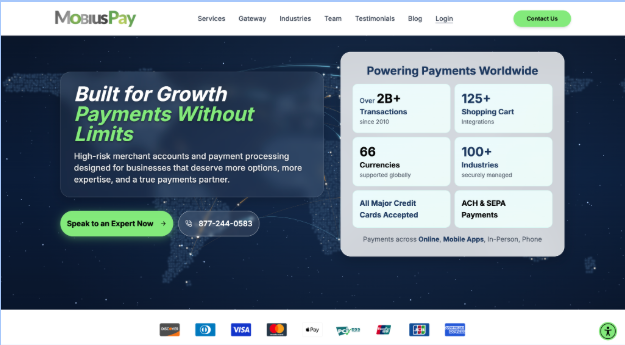
What Does MobiusPay Do? Among providers built specifically around high-risk categories, MobiusPay stands out in 2026 for how much emphasis it places on getting the underwriting narrative right before a merchant ever runs a transaction. Rather than approving quickly and sorting out details later, the team works through fulfillment timing, checkout language, and expected refund patterns upfront.
Why Does MobiusPay Stand Out in the 2026 Underwriting Environment? This upfront diligence tends to prevent the kind of surprise reviews that catch merchants off guard a few months into processing. For businesses in categories such as nutraceuticals and subscription services, where dispute ratios can shift quickly if policies are not clearly communicated to customers, this approach has translated into fewer holds and steadier funding over time. It is a provider suited to merchants who would rather spend more time at onboarding than risk instability later.
Summary of Real User Reviews: Merchants consistently point to fewer surprise account reviews and more predictable funding as the payoff for MobiusPay’s slower, more thorough onboarding. The recurring theme in feedback is that the extra diligence upfront pays for itself once dispute scrutiny tightens.
2. Durango Merchant Services
What Does Durango Merchant Services Do? Durango continues to be a strong option for merchants whose models fall outside what most standard acquirers will touch. Its approach of shopping applications across a network of banks, rather than forcing every merchant into a single processing relationship, remains one of its more valuable traits heading into 2026.
Why Does Durango Merchant Services Stand Out in the 2026 Underwriting Environment? This multi-acquirer approach tends to produce placements that fit the actual risk profile of the business rather than a compromise that works until the first difficult month. Decades of specialization in hard-to-place categories give Durango leverage with underwriters that newer, generalist providers can’t easily replicate.
Summary of Real User Reviews: Durango is consistently described as one of the longest-tenured players focused specifically on hard-to-place merchants, with reviews highlighting durable placements that hold up even as network dispute thresholds tighten.
3. PaymentCloud
What Does PaymentCloud Do? PaymentCloud has kept its focus on account management as much as approval, and that emphasis has aged well as underwriting scrutiny has increased. Merchants working with PaymentCloud consistently mention having a dedicated point of contact who understands their specific vertical.
Why Does PaymentCloud Stand Out in the 2026 Underwriting Environment? That dedicated relationship matters more when a dispute spike or compliance question comes up unexpectedly, rather than when everything is going smoothly. Its scale relative to other specialists on this list also means a broader bench of account managers to draw on when scrutiny increases.
Summary of Real User Reviews: Reviewers consistently cite responsive, vertical-aware account management as PaymentCloud’s strongest differentiator, particularly when compliance questions or dispute spikes arise without warning.
4. Host Merchant Services
What Does Host Merchant Services Do? Host Merchant Services remains a solid choice for businesses with moderate risk profiles who want infrastructure built for scale without sacrificing the underwriting depth that higher-risk categories require.
Why Does Host Merchant Services Stand Out in the 2026 Underwriting Environment? Its dual focus on standard and high-risk processing gives merchants access to more mature systems than some purely high-risk specialists offer, which matters as underwriters expect more sophisticated fraud and reporting tools than they did a few years ago.
Summary of Real User Reviews: Host Merchant Services reports strong year-over-year retention, and reviewers point to its blended infrastructure as a practical middle ground for businesses that don’t fit neatly into either a low-risk or a purely specialist high-risk bucket.
5. Soar Payments
What Does Soar Payments Do? Soar Payments continues to serve merchants that traditional banks decline outright, with particular strength in matching applicants to acquirers based on direct vertical experience.
Why Does Soar Payments Stand Out in the 2026 Underwriting Environment? Its transparency around the tradeoff between faster funding and lower reserve requirements gives merchants a genuine choice rather than a one-size-fits-all structure, which matters more as underwriters ask sharper questions about cash flow and reserve adequacy.
Summary of Real User Reviews: Soar’s fastest-approval reputation continues to hold up in merchant feedback, with reviewers specifically noting the ability to choose a funding-versus-reserve tradeoff that fits their cash flow rather than having one imposed on them.
Research Methodology and Selection Process
Putting together a ranked list of high-risk merchant account providers for 2026 requires more than checking who still advertises high-risk tolerance. A structured research process was followed to make sure each option earned its place based on real signals, not marketing copy.
Initial Data Collection The starting point was building a broad pool of candidates, sourced from software directories, industry review platforms, high-risk merchant forums, and vertical-specific publications, with particular attention to how each provider has responded to tightening card network dispute thresholds.
Shortlisting Phase Once a longlist was established, options with thin or unverifiable review histories were cut, and each remaining provider was examined for review consistency and the absence of red flags like sudden review spikes. Providers with a long track record specifically in high-risk categories, and visible adaptation to the current underwriting environment, got priority.
Verification of Claims Claims about underwriting philosophy, reserve calculation, and account management were cross-referenced against what actual merchants reported in reviews. Where a provider claimed a specific capability, such as multi-acquirer placement or dedicated account management, the research looked for real user confirmation that the feature worked as described.
Authority and Industry Contribution Layer Industry recognition was factored in as a supporting signal of credibility, with providers earning consistent recognition over multiple years carrying more weight than a single one-off mention.
High-Risk Underwriting-Specific Evidence The final filter was depth specific to the 2026 underwriting environment. Each provider was checked for evidence of adapting onboarding to reflect tighter dispute thresholds, transparent reserve policy, and support that stays engaged past the initial approval. Providers with surface-level high-risk branding but no evidence of adapting to current scrutiny were not included.
How to Make the Final Decision
Once you have a shortlist, the comparison should center on funding reliability and reserve policy rather than headline processing rates.
Volume Spike Response: Ask each provider what happens during a 30 percent volume spike. A provider with specifics, rather than reassurances, is more likely to keep your account stable through growth.
Compliance Question Turnaround: Find out how quickly compliance questions get answered once you’re live. Slow answers here tend to predict slow answers during an actual dispute or review.
Account Ownership After Onboarding: Know exactly who owns the account once the onboarding team steps back. A provider that goes quiet after onboarding is one of the more common reasons merchants switch within the first year.
Reserve and Funding Tradeoffs: Understand whether the provider offers a real choice between faster funding and lower reserve requirements, or imposes a single structure regardless of your cash flow needs.
Underwriting Depth for Your Vertical: Confirm the provider’s fraud and chargeback tools are built for your specific category rather than adapted from generic, low-risk retail templates.
Bottom Line
The best merchant account providers for high-risk businesses this year are not necessarily the fastest to approve. They are the ones whose underwriting reflects how your business actually operates, whose reserve and funding policies are transparent from day one, and whose support teams stay engaged well past onboarding. MobiusPay suits merchants who want underwriting depth before their first transaction. Durango Merchant Services fits models that fall outside standard risk tolerance. PaymentCloud works well for merchants who value ongoing account management. Host Merchant Services is a fit for moderate-risk businesses scaling up. Soar Payments suits merchants who want a real choice between funding speed and reserve requirements. Merchants who prioritize these qualities over rate comparisons tend to build processing relationships that last years rather than months.
This post may contain affiliate links.
More Recommended Ebike/Scooters
Check out these other ebikes and scooters I've reviewed:
- Urban Arrow Ebike – Last year, I made one of the largest purchases I’ve ever made – I bought a $9,000 electric cargo bike from Urban Arrow. In my Urban Arrow review, I will discuss what it is and why I decided to buy this bike, as well as discuss how impactful a bike like this can be on your journey to financial independence.
- Troxus Explorer Step-Thru Ebike – The Troxus Explorer Step-Thru is a fat-tire ebike that I’ve had the pleasure of riding for a while now. It has amazing power, great looks, and awesome range. If you’re looking for a great fat-tire ebike that offers a lot for the price, the Troxus Explorer Step-Thru is definitely one for you to consider. Check out my Troxus Explorer Step-Thru Review.
- Hovsco HovBeta Ebike – The HovBeta is a folding ebike with great specs and a lot of interesting features, and importantly, it’s sold at a good price point. I’ve had a blast commuting with it and using it to do deliveries with DoorDash, Uber Eats, and Grubhub. Check out my Hovsco HovBeta Ebike Review.
- Vanpowers Manidae Ebike – The Vanpowers Manidae is a fat tire ebike that I’ve been riding as my primary winter commuting bike and have also been using it to do food delivery with apps like DoorDash, Uber Eats, and Grubhub. After clocking in a decent number of miles with this ebike, I wanted to write a post sharing what my experience with the Vanpowers Manidae ebike has been like. Check out my Vanpowers Manidae Review.
- Sohamo S3 Step-Thru Folding EBike Review – A Great Value Folding Ebike – The Sohamo S3 Step-Thru Folding Ebike is an entry-level folding ebike that offers a lot of value for the price point. I’ve been riding the Sohamo S3 for a while now, putting the bike through its paces, and I have to say, this bike has exceeded all of my expectations. Check out my Sohamo Review.
- KBO Flip Ebike – The KBO Flip is an excellent bike. I’ve had a great time riding it and think it’s a versatile bike that can be used for a lot of purposes and can fit a variety of lifestyles. It’s worked out great for me as a general commuter bike and as a food delivery bike. Check out my KBO Flip Review.
- Hiboy P7 Commuter Ebike – The Hiboy P7 is an excellent electric commuter bike that’s offered at an affordable price point. The range and speed of this bike are both very good, so you won’t have any trouble getting anywhere you need to go with it. As a food delivery vehicle, this is also good – with how much range it offers, you’ll be able to work all day on a single charge. Check out my Hiboy P7 Commuter Electric Bike Review.
- Himiway Escape Ebike – The Himiway Escape is an interesting bike for anyone looking for a moped-style ebike. If you’re a gig economy worker, the Himiway Escape is particularly interesting and it’s possible to think of it as an investment, especially if you can opt to do deliveries with the Himiway versus using a car. It’s not cheap, but you can definitely make your money back when you compare the mileage you’ll put on your car versus using an ebike. Check out my Himiway Escape Bike Review.
- Espin Sport Ebike – The Espin Sport is a good ebike for someone who is looking for an ebike that feels and rides more like a regular bike. There are many ebikes that are really only bikes in name. In reality, they’re basically electric mopeds. The Espin Sport, by contrast, is a bike you could probably ride without the battery and you’d feel like you’re just riding a regular bike. Check out my Espin Sport Review.
- Varla Eagle One Scooter – The Varla Eagle One is an excellent scooter that can make sense for a lot of people. It can work as a primary mode of transportation. You can use it to work on gig economy apps like DoorDash, Uber Eats, and Grubhub. And it can also be a recreational vehicle if you’d prefer to use it for that. Check out my Varla Eagle One Review.
- Varla Falcon Scooter – The Varla Falcon is an excellent scooter that offers a good amount of power at a lower price point compared to more powerful scooters. It’s not exactly an entry-level scooter, nor is it a high-powered scooter. I think it fits somewhere in-between those two categories – an intermediate scooter if I had to give it a category. Check out my Varla Falcon Review.
- Hiboy S2 Scooter – The Hiboy S2 is an excellent entry-level commuter scooter that's perfect for someone looking to save some money in transportation costs and improve their commute. Check out my Hiboy S2 Review.
- Hiboy S2R Scooter – The Hiboy S2R is one of the more interesting electric scooters I’ve been able to test out. It’s not a high-powered scooter, but for an everyday transport option, it’s very useful, especially given some of the unique features that it has. Indeed, for the price, the Hiboy S2R might be the best value scooter I’ve used. Check out my Hiboy S2R Review.
- Fucare H3 Scooter – The Fucare H3 is a fun scooter and I’ve enjoyed testing it out. For a daily commuter or quick trips or errands, the Fucare H3 is probably the scooter I’ll use. It’s portable and easy to maneuver, so it’s just easier to take on the road when I need it. Check out my Fucare H3 Scooter Review.
More Recommended Investing App Bonuses
For additional investing app bonuses, be sure to check out the ones below:
- M1 Finance ($75) – This is a great robo-advisor that has no fees and allows you to create a customized portfolio based on your risk tolerance. You also get $75 for opening an account. Check out my M1 Finance Referral Bonus – Step-By-Step Guide.
- SoFi Invest ($25) – SoFi Invest is an easy brokerage account bonus that you can earn with just a few minutes of work. Use my SoFi Invest referral link, fund your SoFi Invest brokerage account with just $10 and you’ll get $25 of free stock. I also have a step-by-step guide for the SoFi Invest referral bonus.
- Robinhood (1 free stock) – Robinhood gives you a free stock valued between $2.50-$225 if you open an account using my referral link.
- Public (1 free stock) - Public gives you a free stock valued between $3-$70 if you open an account using my referral link.
More Recommended Bank Account Bonuses
If you’re looking for more easy bank bonuses, check out the below options. These bonuses are all easy to earn and have no fees or minimum balance requirements to worry about.
- Ally Bank ($100) – Of all the banks out there, Ally is, without a doubt, my favorite. At the moment, Ally is offering $100 to customers who open an eligible Ally account and meet the requirements. Here are the step-by-step directions to earn your Ally Bank referral bonus.
- Chime ($100) - Chime is a free bank account that offers a referral bonus if you use a referral link and complete a direct deposit of $200 or more. In practice, any ACH transfer into this account triggers the bonus. This bonus is easy to earn and posts instantly, so you’ll know if you met the requirements as soon as you move money into the account. I wrote a step-by-step guide on how to earn your Chime referral bonus that I recommend you check out.
- US Bank Business ($400/$1200) – This is a fairly easy bank bonus to earn, since there are no direct deposit requirements. In addition, you can open the Silver Business Checking account, which comes with no monthly fees. Check out how to earn this big bonus here.
- Current ($50) – Current is a free fintech bank that’s offering new users a $50 referral bonus after signing up for an account using a referral link. Current is an easy bonus to earn and also gives you access to three savings accounts that pay you 4% interest on up to $2,000. That means you can put away up to $6,000 earning 4% interest. That’s very good and makes Current an account I recommend to everyone. Check out my step-by-step guide on how to earn your Current Bank bonus.
- Novo Bank ($40) - Novo bank is a free business checking account that’s currently offering a $40 bonus if you open a Novo business checking account using a referral link. In addition to being a good bank bonus, Novo is also a good business checking account. It has no monthly fees or minimum balance requirements and operates a good app and website. Indeed, it’s the business checking account I currently use for this blog. Check out my post on how to easily open a Novo account.
- Varo ($25) – Varo is a free fintech banking app similar to Chime or Current. It’s currently offering a $25 bonus to new users that open a new Varo account with a referral link. The bonus for this bank is very easy to meet, all you need to do is spend $20 within 30 days of opening your Varo account. Check out my step-by-step guide to learn how to earn this bonus.

Kevin is an attorney and the blogger behind Financial Panther, a blog about personal finance, travel hacking, and side hustling using the gig economy. He paid off $87,000 worth of student loans in just 2.5 years by choosing not to live like a big shot lawyer.
Kevin is passionate about earning money using the gig economy and you can see all the ways he makes extra income every month in his side hustle reports.
Kevin is also big on using the latest fintech apps to improve his finances. Some of Kevin's favorite fintech apps include:
- SoFi Money. A really good checking account with absolutely no fees. You'll get a $25 referral bonus if you open a SoFi Money account with a referral link, and an additional $300 if you complete a direct deposit.
- 5% Savings Accounts. I'm currently getting 5.24% interest on my savings through a company called Raisin. Opening a Raisin account takes minutes to complete, it's free, and all of your funds are FDIC-insured. I explain how it works, why I'm now using it to store my emergency fund and any other cash savings I have, and why I recommend everyone check it out in this review.
- US Bank Business. US Bank is currently offering new business customers a $400/$1200 signup bonus after opening a new account and meeting certain requirements.
- M1 Finance. This is a great robo-advisor that has no fees and allows you to create a customized portfolio based on your risk tolerance. You also get $75 for opening an account.
- Empower. One of best free apps you can use to monitor your portfolio and track your net worth. This is one of the apps I use to track my financial accounts.
Feel free to send Kevin a message here.

Leave a Reply