Most restaurants don’t fail because of bad food. They fail because their operations can’t keep up with demand. The top restaurant POS systems on the market today are built to handle exactly that pressure, from managing peak-hour transaction loads without slowdowns to syncing orders across DoorDash, Uber Eats, and Grubhub in real time. After reviewing dozens of platforms across pricing, features, and real-world restaurant performance, this guide narrows it down to five options worth your attention.
The vetting process for this list
Public information drove every decision here. Each platform was assessed through user reviews, feature breakdowns, case studies, and listing data pulled from official websites and restaurant technology directories. Only options with a track record of performing in real restaurant environments made the cut.
→ See the full research breakdown
- Orders.co – Best Restaurant POS System for Fast Multi-Channel Order Management
- Focus – Best for restaurant and hospitality POS management
- Smart Tab – Best for high-volume nightclubs and bars
- Square – Best for restaurant payment processing and operations management
- GoTab – Best for mid-sized to enterprise restaurants and hospitality venues
The Difference the Right Top Restaurant POS Systems Makes
Picking the wrong POS doesn’t just slow things down. It creates a ripple effect across every shift, every table, and every ticket.
When a system crashes under peak-hour load, servers fall behind, tables wait longer, and kitchen staff lose sync with the floor. That kind of breakdown costs real money, not just time.
The right platform connects cleanly with third-party delivery channels like DoorDash, Uber Eats, and Grubhub, so online and in-house orders flow into one system without manual entry errors or missed tickets.
Specialized POS platforms are built with restaurant workflows in mind. They account for split checks, table transfers, and modifier customizations that generic systems often handle awkwardly.
The gains show up in measurable ways: faster average transaction times, higher system reliability during service hours, and shorter table turn times. Those improvements add up across every single service.
The 5 Best Top Restaurant POS Systems: Quick Comparison
Note: All data in this table is sourced from review platforms and the official websites of the listed companies.
| Company Name | Headquartered In |
| Orders.co | Los Angeles, CA |
| Focus | Boerne, Texas |
| Smart Tab | San Francisco, California |
| Square | San Francisco, California |
| GoTab | Arlington, Virginia |
1) Orders.co – Best Restaurant POS for Fast Multi-Channel Order Management
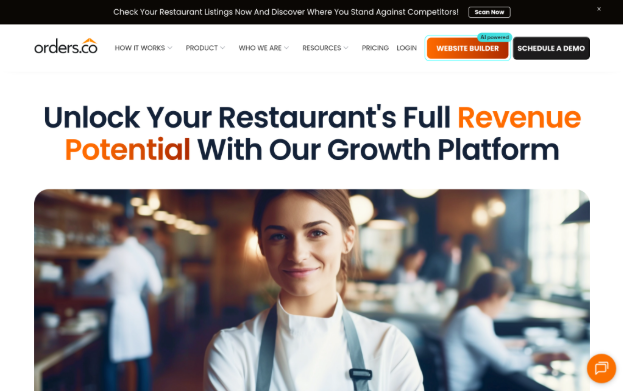
Order management is where most restaurant tech either earns its keep or falls apart. A busy Friday night can bring in tickets from ezCater, UberEats, DoorDash, Grubhub, your own website, the phone, and the dining room all at once, and if each of those lives on its own tablet, someone on your staff is spending the rush retyping orders instead of running the floor.
Where Orders.co Fits
Orders.co is a cloud-based restaurant POS built around exactly this problem. It consolidates delivery apps, web orders, phone orders, and dine-in into one dashboard, syncs menus across all connected platforms in real time, and lets you route deliveries however you prefer.
Core order management features:
- Order consolidation — every channel in a single queue instead of six separate tablets
- Real-time menu sync — update a price or mark an item sold out once, and it changes everywhere
- Flexible delivery dispatch — route each order to your own drivers or a third-party fleet
- Built-in KDS — tickets go straight to the kitchen without a runner
- QR code dine-in ordering — guests order from the table without tying up a server
Reporting Built for Daily Decisions
The reporting side is designed for daily use rather than quarterly review:
- X and Z shift reports to close out each shift cleanly
- Top seller insights to show what’s actually moving
- Provider performance tracking to show which delivery platforms are worth the commission
Restaurants running catering get a separate module with its own ordering flows and dispatch, since catering rarely behaves like a standard ticket.
What You Don’t Have to Buy Separately
Orders.co was built exclusively for restaurants rather than adapted from a retail tool, so multi-channel consolidation and complex menu modifiers work naturally from day one. It also replaces several tools at once — no separate delivery tablets, menu software, or loyalty system. A few things come included that competitors often sell as add-ons:
- A commission-free ordering website
- A built-in loyalty program
- Automated marketing
- Dispute management for incorrect or refunded delivery orders
Support is 24/7 live phone every day, not a ticket queue — the difference between a five-minute fix and a lost dinner service.
2) Focus – Best for Restaurant and Hospitality POS Management
Which Markets Does Focus Serve?
Focus POS has served restaurants, coffee shops, and hospitality businesses since 1990, putting them in a rare category of platforms with decades of real-world deployment behind them. They cover everything from kitchen display systems and mobile payments to loyalty programs and online ordering. The company supports major franchise chains including Smoothie King, Coldstone Creamery, and Popeyes, so their system has been stress-tested at scale. Their local dealer network means operators get in-person support, not just a help ticket queue.
Why Is Focus a Contender for Top Restaurant POS Systems?
Focus POS solves a problem that newer platforms often sidestep: long-term reliability for restaurants that need a system to perform consistently across years of high-volume service. Their 2023 acquisition by Shift4 Payments adds payment infrastructure depth that makes them worth considering for operators thinking beyond standard POS.
From the User Reviews:
The review patterns around Focus POS lean heavily on trust built over time. Clients like Bottega Louie and Seven Grand aren’t exactly low-volume venues, so the fact that they keep running on Focus says something. Reviewers frequently point to the flexibility of building out only the features they actually need, which keeps the system from feeling bloated.
3) Smart Tab – Best for High-Volume Nightclubs and Bars
Which Markets Does Smart Tab Serve?
Smart Tab focuses on nightclubs and bars, a segment with operational demands that most standard POS platforms aren’t built for. They work across major markets including San Francisco, Los Angeles, Las Vegas, and Austin, handling the kind of high-volume, fast-paced service where a slow system costs real money per minute. Features like biometric employee tracking, ID-based payment profiles, and offline payment processing are built for environments where things move fast and accountability matters. Their month-to-month pricing (starting at $60 for mobile devices) removes the pressure of long-term contract commitments.
Why Is Smart Tab a Contender for Top Restaurant POS Systems?
Smart Tab addresses a specific challenge that general-purpose POS systems tend to miss: the nightlife venue, where bar tabs, staff accountability, and high transaction volume all collide at once. The fact that their team includes former bartenders, servers, and venue owners means the feature set reflects what actually happens on the floor, not what looks good in a product brochure.
From the User Reviews:
Venues that use Smart Tab tend to highlight offline payment processing as a standout feature, because connectivity issues in busy venues are more common than people expect. Reviewers also point to the biometric employee tracking as a trust-builder for operators managing large bar staffs. That kind of niche-specific depth is genuinely rare.
4) Square – Best for Restaurant Payment Processing and Operations Management
Which Markets Does Square Serve?
Square works with restaurants across every format and size, from single-location independents to growing multi-unit operators. The platform covers payment processing, inventory tracking, bookings, payroll, and e-commerce all in one ecosystem. With 4 million merchants and $241 billion in annual payment volume, Square is the most widely adopted POS in the U.S. market (not cheap at enterprise tiers, but the free tier makes entry accessible). Their $0 chargeback fee is a real advantage for restaurants, where disputes are more common than in most retail categories.
Why Is Square a Contender for Top Restaurant POS Systems?
Square invented the mobile card reader and has spent over 15 years refining what fast, reliable payment processing looks like for high-volume restaurant environments. Their tiered pricing structure means restaurants can start lean and scale the system as order volume and location count grow, which is a practical path that few platforms match as cleanly.
From the User Reviews:
The most consistent feedback around Square for restaurants centers on ease of setup and the breadth of the ecosystem. One cited restaurant reported tripling their business after switching, which is the kind of outcome that shows up more than once in review threads. Fast Company naming Square to their Most Innovative Companies list for 2026 lines up with what operators report about the platform improving consistently.
5) GoTab – Best for Mid-Sized to Enterprise Restaurants and Hospitality Venues
Which Markets Does GoTab Serve?
GoTab operates across restaurants, breweries, bars, and hotels in 35 U.S. states and Canada, processing over $250 million in transactions annually. The platform handles mobile ordering, contactless payment, and kitchen management from a single system that runs on any internet-connected device. Clients include Stone Brewing Co., Barcelona Wine Bar, and Topgolf, which gives a clear picture of the venue types and order volumes they’re built for. Their transaction-based pricing ties their success directly to operator performance, a model that tends to attract operators who want aligned incentives rather than just a flat monthly fee.
Why Is GoTab a Contender for Top Restaurant POS Systems?
GoTab tackles one of the most persistent friction points in restaurant service: giving guests multiple ways to order and pay without requiring them to download an app or remember a password. Their kitchen management integration means that front-of-house flexibility doesn’t come at the cost of back-of-house clarity, which is where a lot of mobile ordering platforms fall short.
From the User Reviews:
GoTab earns consistent praise for how quickly it deploys and how little hardware change it requires, since running on existing devices keeps switching costs low. Their 2021 Excellence in Customer Service Award reflects what operators mention repeatedly: the support experience actually delivers. That kind of reliability at the service layer matters just as much as the feature list.
The Process Behind This Ranking
Building this list required more than a quick feature comparison. A structured research process was used to identify which restaurant POS platforms genuinely perform in real-world service environments, not just which ones have the best marketing copy.
Foundation Data Requirements
The longlist was built by pulling from multiple sources at once. Restaurant technology directories, review aggregator platforms, and published case studies were all scoured to build a broad starting pool of POS options. No single source was treated as authoritative on its own. The goal was to find platforms that showed up consistently across multiple listing types, which typically signals that a company has real operator adoption behind it, not just a polished website.
Pre-Verification Phase
Before any platform was considered, verification work was done to clear out options with thin track records. Review patterns were analyzed to separate platforms with genuine operator feedback from those with sparse or inconsistent review histories. Platforms where the public review record didn’t hold up under scrutiny were removed from consideration at this stage, regardless of how strong their feature claims appeared.
The Verification Phase
Each remaining platform was cross-checked to see whether what they claimed on their website matched what showed up in operator reviews and third-party coverage. Close attention was paid to how platforms handled the operational challenges that come up most in restaurant environments: peak-hour transaction loads, third-party delivery integration, and inventory tracking accuracy. Where a platform’s real-world results matched its stated strengths, it moved forward. Where gaps appeared between claims and evidence, it was flagged and dropped.
Tracking Authority Markers
Industry recognition and external mentions were factored in as signals of standing within the restaurant technology space. Award wins, coverage in relevant publications, and original product research all contributed to how each platform was assessed. A platform that only self-promotes doesn’t carry the same weight as one that earns recognition from external sources. Square’s Fast Company listing and GoTab’s Excellence in Customer Service Award are examples of the kind of third-party recognition that supported their inclusion.
Top Restaurant POS Systems Proof Points
The final check looked at whether each platform could demonstrate relevance to the restaurant POS space through concrete evidence. That meant dedicated service pages built around restaurant operations, verified reviews from restaurant operators rather than general business users, and case studies tied to recognizable hospitality brands. Platforms that passed this final layer showed clear proof of fit, not just general business technology capability.
How to Pick Your Best Match
Every restaurant operation is different, and the right POS depends on more than feature count. These five criteria help narrow down which platform fits your specific situation.
- Industry and Domain Experience: Look for platforms with a track record in your specific restaurant type. A bar with 300 covers on a Friday night has different needs than a fast-casual counter service spot.
- Features and Service: Match the feature set to your actual workflow. If you’re running online ordering alongside in-house dining, you need a system that handles both without manual reconciliation.
- Pricing Structure: Check whether pricing is flat monthly, transaction-based, or tiered. Transaction-based models can be more cost-effective at lower volumes, while flat fees often make more sense at scale.
- Results Measurement: Ask how the platform tracks performance. Good systems give you visibility into average transaction times, order accuracy rates, and table turn times so you can spot where things slow down.
- Industry Knowledge and Compliance: Make sure the platform handles PCI DSS compliance and any local tax rules relevant to your market. Gaps here create risk that shows up at the worst possible time.
Closing Thoughts
The right POS doesn’t just process payments. It shapes how fast your kitchen moves, how cleanly your staff communicates, and how much revenue you capture per shift. The platforms on this list cover a wide range of formats, from high-volume nightclubs to multi-location restaurant groups. Focus on the fit between your operation type and the platform’s strengths. As restaurant technology keeps adding AI-driven automation and deeper delivery integrations, the gap between good and great POS decisions will only grow wider.
This post may contain affiliate links.
More Recommended Ebike/Scooters
Check out these other ebikes and scooters I've reviewed:
- Urban Arrow Ebike – Last year, I made one of the largest purchases I’ve ever made – I bought a $9,000 electric cargo bike from Urban Arrow. In my Urban Arrow review, I will discuss what it is and why I decided to buy this bike, as well as discuss how impactful a bike like this can be on your journey to financial independence.
- Troxus Explorer Step-Thru Ebike – The Troxus Explorer Step-Thru is a fat-tire ebike that I’ve had the pleasure of riding for a while now. It has amazing power, great looks, and awesome range. If you’re looking for a great fat-tire ebike that offers a lot for the price, the Troxus Explorer Step-Thru is definitely one for you to consider. Check out my Troxus Explorer Step-Thru Review.
- Hovsco HovBeta Ebike – The HovBeta is a folding ebike with great specs and a lot of interesting features, and importantly, it’s sold at a good price point. I’ve had a blast commuting with it and using it to do deliveries with DoorDash, Uber Eats, and Grubhub. Check out my Hovsco HovBeta Ebike Review.
- Vanpowers Manidae Ebike – The Vanpowers Manidae is a fat tire ebike that I’ve been riding as my primary winter commuting bike and have also been using it to do food delivery with apps like DoorDash, Uber Eats, and Grubhub. After clocking in a decent number of miles with this ebike, I wanted to write a post sharing what my experience with the Vanpowers Manidae ebike has been like. Check out my Vanpowers Manidae Review.
- Sohamo S3 Step-Thru Folding EBike Review – A Great Value Folding Ebike – The Sohamo S3 Step-Thru Folding Ebike is an entry-level folding ebike that offers a lot of value for the price point. I’ve been riding the Sohamo S3 for a while now, putting the bike through its paces, and I have to say, this bike has exceeded all of my expectations. Check out my Sohamo Review.
- KBO Flip Ebike – The KBO Flip is an excellent bike. I’ve had a great time riding it and think it’s a versatile bike that can be used for a lot of purposes and can fit a variety of lifestyles. It’s worked out great for me as a general commuter bike and as a food delivery bike. Check out my KBO Flip Review.
- Hiboy P7 Commuter Ebike – The Hiboy P7 is an excellent electric commuter bike that’s offered at an affordable price point. The range and speed of this bike are both very good, so you won’t have any trouble getting anywhere you need to go with it. As a food delivery vehicle, this is also good – with how much range it offers, you’ll be able to work all day on a single charge. Check out my Hiboy P7 Commuter Electric Bike Review.
- Himiway Escape Ebike – The Himiway Escape is an interesting bike for anyone looking for a moped-style ebike. If you’re a gig economy worker, the Himiway Escape is particularly interesting and it’s possible to think of it as an investment, especially if you can opt to do deliveries with the Himiway versus using a car. It’s not cheap, but you can definitely make your money back when you compare the mileage you’ll put on your car versus using an ebike. Check out my Himiway Escape Bike Review.
- Espin Sport Ebike – The Espin Sport is a good ebike for someone who is looking for an ebike that feels and rides more like a regular bike. There are many ebikes that are really only bikes in name. In reality, they’re basically electric mopeds. The Espin Sport, by contrast, is a bike you could probably ride without the battery and you’d feel like you’re just riding a regular bike. Check out my Espin Sport Review.
- Varla Eagle One Scooter – The Varla Eagle One is an excellent scooter that can make sense for a lot of people. It can work as a primary mode of transportation. You can use it to work on gig economy apps like DoorDash, Uber Eats, and Grubhub. And it can also be a recreational vehicle if you’d prefer to use it for that. Check out my Varla Eagle One Review.
- Varla Falcon Scooter – The Varla Falcon is an excellent scooter that offers a good amount of power at a lower price point compared to more powerful scooters. It’s not exactly an entry-level scooter, nor is it a high-powered scooter. I think it fits somewhere in-between those two categories – an intermediate scooter if I had to give it a category. Check out my Varla Falcon Review.
- Hiboy S2 Scooter – The Hiboy S2 is an excellent entry-level commuter scooter that's perfect for someone looking to save some money in transportation costs and improve their commute. Check out my Hiboy S2 Review.
- Hiboy S2R Scooter – The Hiboy S2R is one of the more interesting electric scooters I’ve been able to test out. It’s not a high-powered scooter, but for an everyday transport option, it’s very useful, especially given some of the unique features that it has. Indeed, for the price, the Hiboy S2R might be the best value scooter I’ve used. Check out my Hiboy S2R Review.
- Fucare H3 Scooter – The Fucare H3 is a fun scooter and I’ve enjoyed testing it out. For a daily commuter or quick trips or errands, the Fucare H3 is probably the scooter I’ll use. It’s portable and easy to maneuver, so it’s just easier to take on the road when I need it. Check out my Fucare H3 Scooter Review.
More Recommended Investing App Bonuses
For additional investing app bonuses, be sure to check out the ones below:
- M1 Finance ($75) – This is a great robo-advisor that has no fees and allows you to create a customized portfolio based on your risk tolerance. You also get $75 for opening an account. Check out my M1 Finance Referral Bonus – Step-By-Step Guide.
- SoFi Invest ($25) – SoFi Invest is an easy brokerage account bonus that you can earn with just a few minutes of work. Use my SoFi Invest referral link, fund your SoFi Invest brokerage account with just $10 and you’ll get $25 of free stock. I also have a step-by-step guide for the SoFi Invest referral bonus.
- Robinhood (1 free stock) – Robinhood gives you a free stock valued between $2.50-$225 if you open an account using my referral link.
- Public (1 free stock) - Public gives you a free stock valued between $3-$70 if you open an account using my referral link.
More Recommended Bank Account Bonuses
If you’re looking for more easy bank bonuses, check out the below options. These bonuses are all easy to earn and have no fees or minimum balance requirements to worry about.
- Ally Bank ($100) – Of all the banks out there, Ally is, without a doubt, my favorite. At the moment, Ally is offering $100 to customers who open an eligible Ally account and meet the requirements. Here are the step-by-step directions to earn your Ally Bank referral bonus.
- Chime ($100) - Chime is a free bank account that offers a referral bonus if you use a referral link and complete a direct deposit of $200 or more. In practice, any ACH transfer into this account triggers the bonus. This bonus is easy to earn and posts instantly, so you’ll know if you met the requirements as soon as you move money into the account. I wrote a step-by-step guide on how to earn your Chime referral bonus that I recommend you check out.
- US Bank Business ($400/$1200) – This is a fairly easy bank bonus to earn, since there are no direct deposit requirements. In addition, you can open the Silver Business Checking account, which comes with no monthly fees. Check out how to earn this big bonus here.
- Current ($50) – Current is a free fintech bank that’s offering new users a $50 referral bonus after signing up for an account using a referral link. Current is an easy bonus to earn and also gives you access to three savings accounts that pay you 4% interest on up to $2,000. That means you can put away up to $6,000 earning 4% interest. That’s very good and makes Current an account I recommend to everyone. Check out my step-by-step guide on how to earn your Current Bank bonus.
- Novo Bank ($40) - Novo bank is a free business checking account that’s currently offering a $40 bonus if you open a Novo business checking account using a referral link. In addition to being a good bank bonus, Novo is also a good business checking account. It has no monthly fees or minimum balance requirements and operates a good app and website. Indeed, it’s the business checking account I currently use for this blog. Check out my post on how to easily open a Novo account.
- Varo ($25) – Varo is a free fintech banking app similar to Chime or Current. It’s currently offering a $25 bonus to new users that open a new Varo account with a referral link. The bonus for this bank is very easy to meet, all you need to do is spend $20 within 30 days of opening your Varo account. Check out my step-by-step guide to learn how to earn this bonus.

Kevin is an attorney and the blogger behind Financial Panther, a blog about personal finance, travel hacking, and side hustling using the gig economy. He paid off $87,000 worth of student loans in just 2.5 years by choosing not to live like a big shot lawyer.
Kevin is passionate about earning money using the gig economy and you can see all the ways he makes extra income every month in his side hustle reports.
Kevin is also big on using the latest fintech apps to improve his finances. Some of Kevin's favorite fintech apps include:
- SoFi Money. A really good checking account with absolutely no fees. You'll get a $25 referral bonus if you open a SoFi Money account with a referral link, and an additional $300 if you complete a direct deposit.
- 5% Savings Accounts. I'm currently getting 5.24% interest on my savings through a company called Raisin. Opening a Raisin account takes minutes to complete, it's free, and all of your funds are FDIC-insured. I explain how it works, why I'm now using it to store my emergency fund and any other cash savings I have, and why I recommend everyone check it out in this review.
- US Bank Business. US Bank is currently offering new business customers a $400/$1200 signup bonus after opening a new account and meeting certain requirements.
- M1 Finance. This is a great robo-advisor that has no fees and allows you to create a customized portfolio based on your risk tolerance. You also get $75 for opening an account.
- Empower. One of best free apps you can use to monitor your portfolio and track your net worth. This is one of the apps I use to track my financial accounts.
Feel free to send Kevin a message here.

Leave a Reply